Carbon dioxide draws mosquitoes in from a distance, and a specific blend of skin-emitted compounds, chiefly lactic acid and ketoglutaric acid, tells them where to land. Heat, humidity, and visual contrast fine-tune the approach once a mosquito is close. Skin bacteria vary from person to person, which is why two people standing in the same yard can have wildly different bite counts.
Tonight, that means two things actually move the needle: cool down and dry off before you head outside, and put an EPA-registered repellent on any skin you’re not covering.
- CO2 plus skin odor compounds do most of the recruiting work.
- Heat, humidity, and dark or high-contrast clothing seal the deal at close range.
- Sweat, exercise, and pregnancy amplify all of the above at once.
A wind-tunnel study found that a two-compound blend of lactic and ketoglutaric acid triggered landing behavior in Aedes aegypti comparable to real human skin odor, evidence that specific chemistry, not just body heat, drives the decision to bite.
Key Takeaways
Mosquitoes bite because carbon dioxide and skin-emitted odor compounds work together to guide them from a distance to a precise landing spot on warm, moist skin.
| Point | Details |
|---|---|
| CO2 starts the search | It activates host-seeking and triggers upwind flight but rarely causes landing by itself. |
| Skin chemistry closes the deal | Lactic and ketoglutaric acid blends trigger landing behavior similar to real human odor. |
| Microbiome drives individual differences | Bacteria convert sweat into the specific VOCs that make some people more attractive than others. |
| Weather changes exposure | Wind above 10 to 14 mph and temperatures outside 60 to 80°F both suppress mosquito activity. |
| Layer your defenses | Combine an EPA-registered repellent with breathable, chemical-free mesh clothing like Bugawaygear’s for coverage that doesn’t rely on a single method. |
Table of Contents
- What Attracts Mosquitoes and How They Track You Down
- The Skin Chemistry Behind Every Bite
- Heat, Humidity, and Visual Cues That Seal the Deal
- Why Some People Get Bitten More Than Others
- Practical Steps to Cut Your Mosquito Bites
- How Wind and Temperature Change Your Bite Risk
- Why Dusk and Dawn Are Prime Biting Hours
- What the Research Actually Tells Us to Prioritize
- A Chemical-Free Way to Cut Off the Signal Mosquitoes Follow
- Frequently Asked Questions
- Sources
What Attracts Mosquitoes and How They Track You Down
Host-seeking isn’t a single trigger. It’s a sequence, and each stage hands off to the next.
- Activation. A resting mosquito senses rising CO2 and switches into search mode, launching into upwind flight toward the source.
- Long-range orientation. As it moves closer, skin-odor compounds join the CO2 plume, sharpening the flight path.
- Short-range convergence. Within a few feet, heat and humidity around exposed skin narrow down exactly where to hover.
- Landing. Visual contrast and skin texture finish the decision, often within inches of contact.
A review of host-seeking behavior describes this as a layered system where CO2 and skin odor act synergistically rather than as separate, additive signals. Neither cue alone reliably produces landing. Together, they do.
Species differences matter here too. Aedes aegypti leans heavily on skin-odor blends at close range, while Anopheles and Culex species often need active sweating or elevated body heat before they respond to human odor at all, even outdoors. That’s one reason bite pressure can swing so much between a still, humid evening and a breezy, dry one.
The Skin Chemistry Behind Every Bite
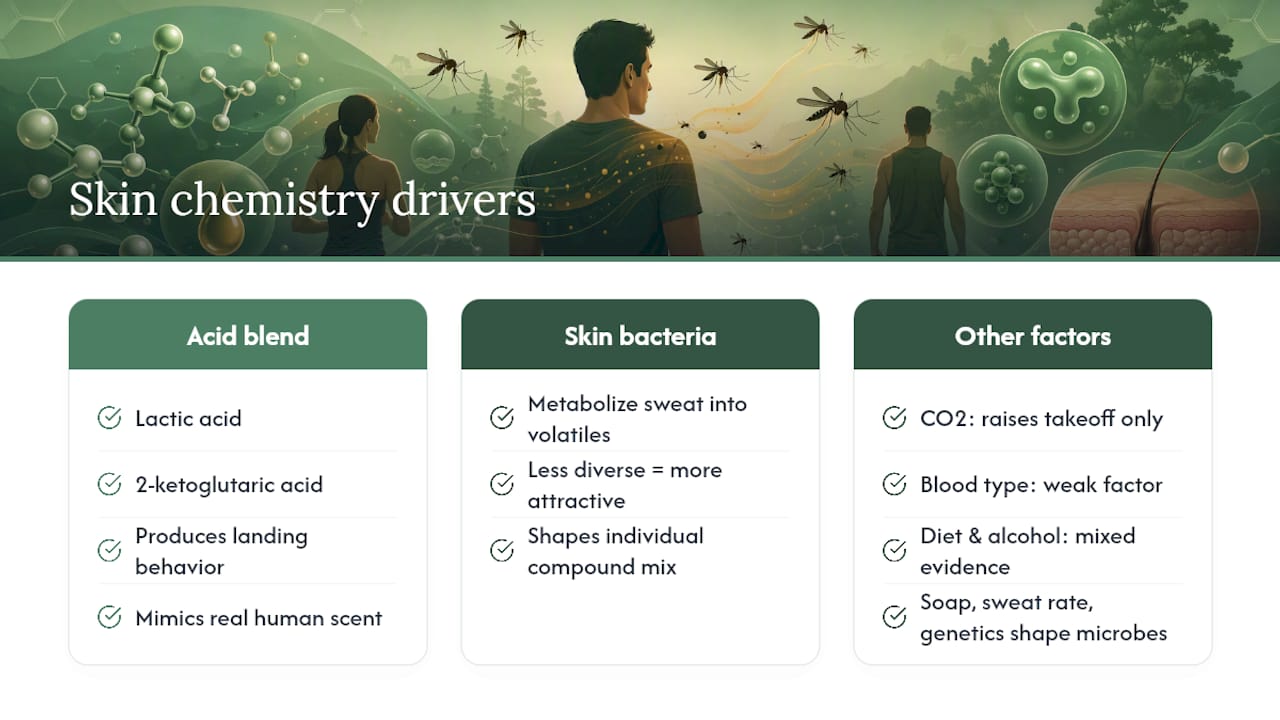
Two compounds keep showing up in lab work as reliable landing cues: lactic acid and 2-ketoglutaric acid. A study published via Springer found that this specific blend, applied without any other skin odors, produced upwind flight and landing behavior in Aedes aegypti nearly matching real human scent. CO2 alone raised takeoff rates but didn’t reliably close the deal. The acid blend did.
Skin bacteria are the reason this chemistry varies from person to person. Sweat itself is largely odorless. Bacteria living on skin metabolize it into the volatile compounds mosquitoes actually detect, and research comparing individual attractiveness found that people who draw more mosquito attention tend to carry a less diverse, more concentrated bacterial community. NIH-supported research similarly links elevated carboxylic acid levels on skin to higher attractiveness.
The compounds that make skin attractive aren’t fixed traits you’re born with in isolation. They’re a byproduct of which bacteria happen to be living on you, and that population is shaped by everything from soap to sweat rate to genetics.
Blood type gets far more attention than the evidence supports. A broader review of individual variation treats it as a weak factor at best, overshadowed by microbiome composition and combined chemical cues. Diet and alcohol show similarly mixed results across studies. If you’re chasing a single dietary fix, you’re chasing the wrong variable.
Heat, Humidity, and Visual Cues That Seal the Deal
CO2 gets a mosquito moving, but it doesn’t automatically get you bitten. It’s better understood as a gate than a landing signal. A field study on Anopheles and Culex found that human odor alone barely attracted mosquitoes in open-air settings unless the subject was actively sweating and warm; wet, heated clothing at 37°C drew 20 to 50 percent more mosquitoes than dry samples at the same temperature.
- Mosquitoes respond to skin just a few degrees warmer than surrounding air.
- Moist, humid skin reads as a stronger target than dry skin.
- Dark colors and high-contrast clothing patterns increase landing rates at short range.
Pro Tip: If you’re going to be active outdoors, breathable, light-colored layers do double duty: they reduce the warm, humid microclimate against your skin, and they cut the visual contrast mosquitoes use to zero in on a landing spot.
Why Some People Get Bitten More Than Others
Attractiveness isn’t random, and it isn’t stable across everyone equally, but a handful of factors consistently push the numbers up or down.
- Pregnancy raises CO2 output and body temperature, and multiple studies tie it to increased mosquito attraction.
- Body size and exercise both increase CO2 production and skin temperature, temporarily during a workout or chronically for larger body mass.
- Skin microbiome and genetics create durable, individual differences that can persist for years, which is why some people seem to be magnets no matter where they travel.
- Diet and alcohol show inconsistent effects across studies, not the reliable link that folklore suggests.
- Blood type correlates weakly at best, and shouldn’t guide any real prevention decision.
The PMC review on individual variation notes that combined cues explain far more of the variation between people than any single factor tested in isolation. That’s the practical takeaway: stacking defenses against multiple cues beats obsessing over one.
Practical Steps to Cut Your Mosquito Bites
Once you know which signals matter, prevention becomes a matter of blocking as many as you reasonably can, layered together rather than relying on one fix.
- Wear light-colored, loose, breathable layers. Loose fabric keeps skin cooler and drier, and lighter colors reduce the visual contrast mosquitoes use to target a landing spot.
- Add a physical barrier for high-exposure activity. Mesh clothing blocks both bite access and much of the skin-odor plume that draws mosquitoes closer in the first place.
- Eliminate standing water around your home. Even a bottle cap’s worth can support breeding, and the CDC names this among the top household interventions.
- Install or repair window and door screens to keep mosquitoes from ever getting indoors.
- Avoid peak activity windows when the species common in your area are most active.
Pro Tip: Combining a repellent with breathable protective clothing covers both the chemical signal and the physical opportunity, which matters more than either measure alone. Layering strategies for longer trips are worth planning ahead, especially for backpacking or multi-day outdoor exposure.
Escalate beyond routine prevention if you notice a local mosquito-borne disease outbreak, develop a severe allergic reaction to bites, or suspect symptoms of a vector-borne illness like West Nile virus. Those situations call for a doctor, not just a stronger repellent.
How Wind and Temperature Change Your Bite Risk
Weather does more to mosquito activity than most people assume. Wind above roughly 10 to 14 mph disrupts a mosquito’s ability to track odor plumes and fly upwind toward a target, which is why bite pressure often drops sharply on breezy evenings even when temperatures are ideal for mosquito activity. Calm, still air lets CO2 and skin-odor plumes travel farther and stay concentrated, giving mosquitoes a clearer trail to follow.
Temperature works in a narrower band than people expect. Most common mosquito species are most active between roughly 60°F and 80°F, with activity dropping off sharply below 50°F and slowing again above the mid-90s as mosquitoes seek shade and moisture instead of hosts. Within that comfortable range, though, a warm body still reads as a stronger target than the surrounding air, which is part of why exercise and heat exposure raise bite risk even on a mild day.
Humidity compounds both effects. Damp air after rain, near standing water, or close to dense vegetation extends the range at which odor and heat signals stay detectable, while dry, breezy conditions shorten it. If you’re picking a time and place for outdoor work or a hike, a warm, humid, windless evening near water is close to the worst combination physics can hand a mosquito. A hot, dry, breezy afternoon is close to the best case for staying bite free, weather permitting.

Why Dusk and Dawn Are Prime Biting Hours
Most of the mosquito species people encounter in backyards and on trails are crepuscular, meaning they’re most active at dawn and dusk rather than at midday or in full darkness. Light levels during those windows match the visual sensitivity many species evolved for host detection, and temperatures tend to sit in that comfortable 60 to 80°F range without the direct sun that pushes mosquitoes into shaded resting spots.
That said, activity patterns vary by species enough to matter. Aedes mosquitoes, including the species that carries dengue and Zika, are notorious for biting throughout the day, particularly in shaded or overcast conditions, not just at twilight. Culex species, which carry West Nile virus in much of the country, tend to follow the classic dusk-into-night pattern more closely.
Practically, this means dawn and dusk deserve your heaviest defenses; repellent, protective clothing, or both, if you’re outdoors during those windows. But daytime shade near standing water or dense brush isn’t automatically safe, especially in regions where Aedes species are common. Treat activity level as a spectrum tied to light, temperature, and species mix rather than a hard curfew you can plan entirely around.
What the Research Actually Tells Us to Prioritize
Most mosquito advice fixates on the wrong lever. Blood type gets outsized attention online despite weak evidence, while the skin microbiome, the actual engine converting sweat into attractive compounds, barely gets mentioned outside entomology journals. That’s backwards. If you want to understand your own bite risk, the honest answer has more to do with your bacterial ecosystem and your body heat than your blood.
The bigger blind spot, though, is how much conventional advice treats repellents as the only real defense. Sprays work, and the CDC’s guidance on them is solid. But repellents wash off, wear thin in heat, and require reapplication that most people skip on a long hike. A physical barrier doesn’t degrade over a sweaty afternoon, and it addresses the mechanism directly: it blocks the skin-odor plume and the landing surface at the same time, rather than trying to mask one signal chemically.
If you take one thing from the research, it’s this: stack your defenses instead of picking one. Cool skin, covered skin, and a repellent on what’s left uncovered beats any single measure alone.
— Thomas
A Chemical-Free Way to Cut Off the Signal Mosquitoes Follow
Every cue covered above, skin odor, heat, humidity, visual contrast, gets weaker the moment skin is physically covered by breathable mesh. Bugawaygear’s mesh clothing works on exactly that mechanism: it traps a thin layer of air against your skin without sealing in heat, which limits how much of your VOC plume and body warmth actually escapes to draw mosquitoes in, all without a single sprayed chemical.

It’s backed by a 30-day money-back guarantee, and the brand points to more than 500 customers who reported zero tick bites while wearing it. That combination of breathability and near-total mesh coverage is the kind of physical barrier that field studies on sweat-driven attraction suggest actually matters. For long trail days, check out gear built for hikers; for backyard time with kids, the family sets cover smaller sizes without sacrificing coverage. Anglers spending hours near still water, where humidity and standing water both raise bite risk, can find fit-specific options on the fishing protection page. Pick your use case and get sized before your next trip outdoors.
Frequently Asked Questions
What attracts mosquitoes to some people more than others? A blend of carbon dioxide, skin-emitted compounds like lactic and ketoglutaric acid, body heat, and humidity draws mosquitoes in. Individual differences mostly trace back to skin microbiome composition, not blood type.
Are mosquitoes attracted to sweat? Sweat itself isn’t the direct attractant. Skin bacteria break sweat down into volatile compounds mosquitoes can detect, and warm, moist skin from sweating makes those signals stronger and easier to track.
Does carbon dioxide alone make mosquitoes bite? Not reliably. CO2 activates search behavior and long-range flight, but landing depends on skin odor, heat, and humidity working alongside it, according to research on host-seeking behavior.
What scents repel mosquitoes? Oil of lemon eucalyptus is one of the few plant-based options the CDC recognizes as effective when formulated as a registered repellent. DEET, picaridin, and IR3535 remain the most consistently effective active ingredients overall.
Does blood type really affect mosquito attraction? The link is weak. Reviews of individual variation point to skin microbiome and combined chemical cues as far stronger predictors than blood type.
What time of day are mosquitoes most active? Dawn and dusk see the highest activity for most species, though Aedes mosquitoes commonly bite throughout the day, especially in shade or overcast weather.
Does wearing dark clothing attract more mosquitoes? Yes. Dark colors and high-contrast patterns increase landing rates at short range, which is why light-colored, loose-fitting layers are a standard prevention recommendation.
Sources
- Human attractive cues and mosquito host-seeking behavior
- L-lactic and 2-ketoglutaric acids, odors from human skin, govern attraction and landing in host-seeking female Aedes aegypti mosquitoes
- Why Are Some People Tastier to Mosquitoes Than Others? - The Scientist