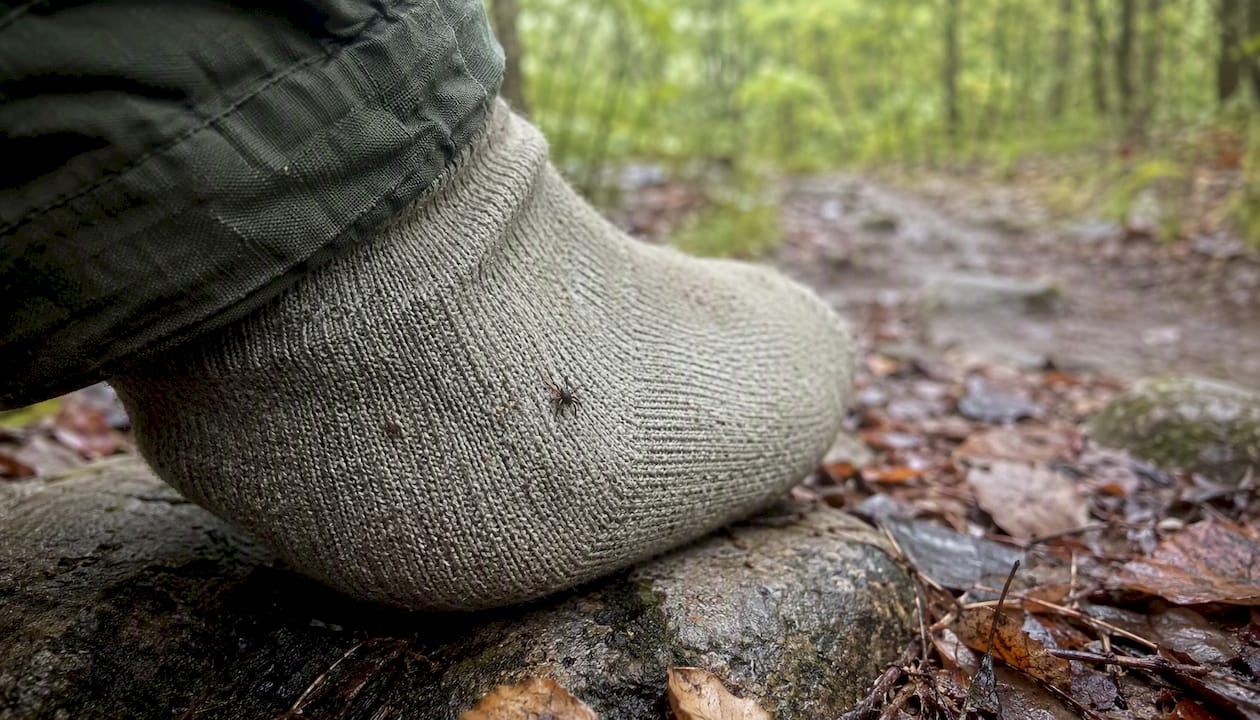
Most ticks cannot bite through socks. A standard sock creates a real physical barrier because ticks need direct skin contact to feed. The catch: larval ticks, sometimes called seed ticks, are small enough to slip through the weave of loose or coarse-knit socks, and they show up in clusters that can number in the hundreds.
- Standard socks usually work against nymphs and adults, which are large enough that a snug sock keeps them from reaching skin.
- Larval ticks are the exception. TickEncounter reports that larvae are small enough to crawl through many standard sock weaves and can attach in large numbers during seed-tick events.
- Tightly woven socks, permethrin-treated socks, or fine-mesh barriers close that gap and reduce risk across all life stages.
Key Takeaways
Most ticks cannot bite through socks, but larval seed ticks are small enough to pass through loose-knit fabrics, making fabric density and integrated coverage the most important variables in real-world protection.
| Point | Details |
|---|---|
| Socks usually block ticks | Nymphs and adults are stopped by standard socks; larvae are the main exception. |
| Larval crawl-through is the real risk | Seed-tick events can put hundreds of larvae on your feet; tightly woven or fine-mesh socks close that gap. |
| LLPI socks reduce lower-extremity bites | A randomized trial found fewer foot and ankle bites with permethrin-impregnated socks, though overall bite rates were not significantly different. |
| Layered clothing steps compound protection | Tuck pants into socks, wear closed-toe shoes, and choose light-colored clothing to spot ticks before they attach. |
| Bugawaygear mesh pants eliminate the ankle gap | Integrated foot coverage in Bug Away Pants removes the most common entry point for ticks without chemicals or reapplication. |
Table of Contents
- Can ticks bite through socks, or do they crawl to exposed skin first?
- Which tick life stages can slip through sock fabric?
- What research says about permethrin-treated socks
- Practical clothing strategies that reduce tick encounters
- How to treat and care for socks and clothing
- What to do after being outdoors
- Physical-barrier mesh clothing as a chemical-free option
- Why layered protection beats any single fix
- Zero chemicals, zero compromises with Bugawaygear
- Sources
Can ticks bite through socks, or do they crawl to exposed skin first?
Ticks don’t jump or fly. They quest: they perch on low vegetation with their front legs extended, waiting to grab onto a passing host. When you walk through brush or tall grass, a tick latches onto your shoe, sock, or pant leg and then crawls upward looking for skin.
That crawling phase is where clothing does its job. A tick that lands on your sock still has to find a gap, an edge, or a thin spot to reach skin. Successful feeding requires attachment to bare skin, so every inch of covered leg is a tick that has to keep moving. Fit matters here. A sock that gaps at the ankle or bunches at the calf creates exactly the kind of opening a tick will find.
Which tick life stages can slip through sock fabric?
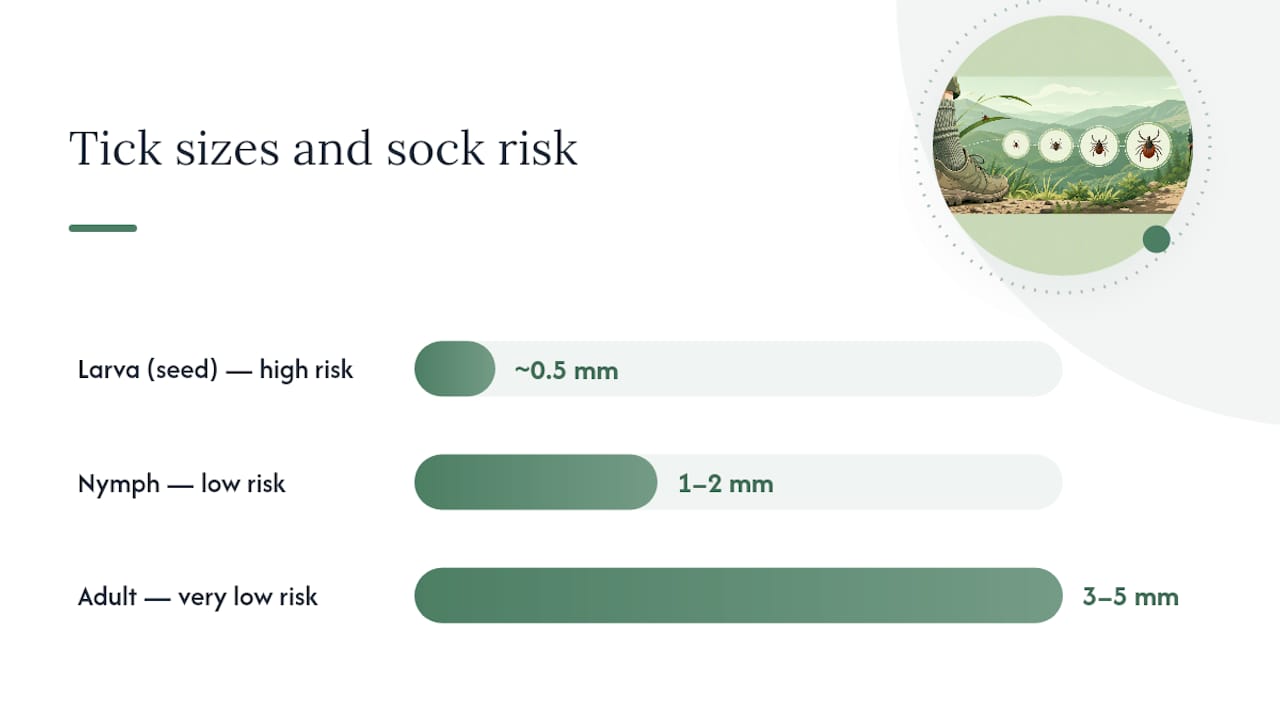
Size is the deciding factor. Adult ticks are roughly the size of an apple seed, nymphs are about the size of a poppy seed, and larvae are barely visible specks with only six legs. That size difference changes everything about how each stage interacts with fabric.
| Life Stage | Approximate Size | Legs | Risk of Passing Through Socks |
|---|---|---|---|
| Larva (seed tick) | ~0.5 mm | 6 | High — can pass through loose or coarse weaves |
| Nymph | ~1–2 mm | 8 | Low — usually stopped by standard socks |
| Adult | ~3–5 mm | 8 | Very low — blocked by nearly all socks |
Larvae are the real problem. They hatch in clusters from a single egg mass, which means a “tick nest” exposure can put hundreds of larvae on your feet and ankles at once. Field reports from TickEncounter describe seed-tick events where many larvae attached directly to toes after crawling through standard sock fabric. Nylon stockings and ultra-fine mesh are more protective than loose cotton or open-knit athletic socks because the mesh openings are simply too small for larvae to pass through.
- Loose cotton or knit socks: higher larval risk, especially in leaf litter or ground-level vegetation.
- Tightly woven synthetic socks: meaningfully better, though not a complete barrier against the smallest larvae.
- Fine-mesh or permethrin-treated socks: the most protective options for high-exposure situations.
What research says about permethrin-treated socks
Permethrin works differently from a repellent. It acts as a contact toxicant: a tick that crawls onto treated fabric is exposed to the chemical and typically dies or is incapacitated before it can reach skin. That mechanism is why permethrin on socks specifically addresses the larval crawl-through problem.
The peer-reviewed evidence is promising but not definitive. A randomized open-label trial published on PMC found that long-lasting permethrin-impregnated (LLPI) socks were associated with significantly fewer lower-extremity tick bites compared to standard socks. Overall tick-bite rates between groups were similar, and the difference was not statistically significant. The study’s authors called for larger trials before drawing firm conclusions. The takeaway: LLPI socks appear to reduce bites at the foot and ankle, which is exactly where larval crawl-through happens, but they are not a standalone solution.
Durability is a practical concern. Factory-impregnated LLPI clothing retains activity through many wash cycles. DIY permethrin sprays, by contrast, need reapplication after a handful of washes, and the protection level varies depending on how evenly the product was applied. EPA guidance on insect repellents covers label requirements and safety information for permethrin-treated clothing, and following those instructions is not optional.
Permethrin-treated socks make the most sense for people with repeated high-risk exposure: outdoor workers, field researchers, or hikers spending long days in tick habitat during larval season (late summer in much of the U.S.). For a casual weekend walk, a tightly woven sock plus tucked pants covers most of the risk.
Practical clothing strategies that reduce tick encounters
The CDC recommends a layered approach: clothing choices, repellents on exposed skin, and tick checks after being outdoors. Here is how to put the clothing piece into practice before you head out.
- Assess your exposure level. A mowed lawn is low risk. Leaf litter, tall grass, and wooded edges are high risk. Adjust your protection accordingly.
- Choose tightly woven socks. Thin athletic socks with an open knit leave gaps. A thicker, tightly woven sock or a purpose-made tick-resistant sock closes them.
- Tuck pants into socks. This forces any tick crawling up your leg to travel over the outside of your clothing rather than finding a direct path to skin. For a proper technique, the Bug Away guide on tucking pants into socks walks through common mistakes.
- Wear closed-toe shoes or boots. Sandals and open shoes give ticks direct access to feet and ankles.
- Choose light-colored clothing. A crossover study published on PubMed found more nymphal and adult ticks collected from light clothing during exposures. The practical reason: ticks are easier to spot on a light background, so you can brush them off before they attach.
- Use gaiters for high-exposure activities. Gaiters cover the gap between boot and pant leg completely. They are especially useful for gardening in leaf litter or hiking through dense undergrowth where tucking alone may not hold.
- Consider integrated-coverage garments. Fine-mesh pants with built-in foot coverage eliminate the gap at the ankle entirely, which is where most tick encounters begin.
Pro Tip: Check that your socks and pant cuffs stay in place during activity. A tuck that slips after 20 minutes of hiking gives ticks a window. Taller socks and a snug pant leg hold the barrier in place longer.
How to treat and care for socks and clothing
There are two ways to get permethrin protection on your clothing: buy factory-impregnated garments or apply a DIY spray yourself. They are not equivalent.
Factory LLPI clothing is treated during manufacturing with a process that bonds permethrin to the fabric fibers. That bond holds through many wash cycles, which means you get consistent protection without remembering to reapply. DIY permethrin sprays are effective when applied correctly, but the protection degrades faster with washing and depends heavily on even coverage. If you go the DIY route, reapply after every few washes and inspect the fabric for thin spots.
For laundering treated clothing, follow the product label. Warm water and a standard dryer cycle are generally fine, but high heat over time can degrade both the fabric and the treatment. Replace socks when the fabric thins, since a worn-out sock loses both its physical barrier and its chemical protection. Permethrin clothing safety guidance covers wash durability in more detail.
Safety notes worth keeping in mind: apply permethrin sprays outdoors or in a well-ventilated space, keep the product off your skin while it is wet, and let treated items dry fully before wearing. EPA label guidance specifies that permethrin is for clothing only, not for direct skin application. If you have infants in the household, check the product label before using treated items near them.
What to do after being outdoors
Coming indoors is not the end of tick exposure. A tick that hitched a ride on your clothing can still find skin if you do not act quickly.
- Shower within two hours if possible. Clinical guidance from Dr. Daniel Cameron notes that showering soon after outdoor exposure can wash off unattached ticks and makes a thorough check easier. An already-attached tick will not wash off in the shower.
- Do a full-body tick check. Work systematically from feet upward. Pay close attention to ankles, behind the knees, the groin, armpits, behind the ears, and the scalp. Ticks favor warm, hidden spots.
- Check your gear and pets. Ticks can ride in on a backpack, jacket, or dog and attach hours later.
- Tumble dry clothing on high heat for 10 minutes. Heat kills ticks on fabric more reliably than washing alone.
- Remove attached ticks with fine-tipped tweezers. Grasp the tick as close to the skin as possible and pull straight out with steady pressure. Disinfect the bite site afterward. If local health guidance recommends saving the tick for testing, seal it in a bag with the date noted.
- Watch for symptoms. A bull’s-eye rash (erythema migrans), fever, fatigue, or muscle aches in the days or weeks after a tick bite are reasons to contact a healthcare provider promptly.
Physical-barrier mesh clothing as a chemical-free option
Permethrin-treated socks solve the larval crawl-through problem chemically. Fine-mesh clothing solves it mechanically, and for some people that distinction matters a lot.
Ultra-fine mesh works by making the physical openings in the fabric smaller than a tick’s body. A larva that lands on the surface cannot pass through because there is no gap large enough. No chemical exposure, no reapplication schedule, no label to follow. That simplicity is the main reason families with small children, gardeners who spend hours in leaf litter, and hikers who find the permethrin routine impractical tend to prefer this approach. For anyone looking at chemical-free tick protection, integrated mesh garments are the most maintenance-light option available.
Bugawaygear’s Bug Away Pants for Women and Bug Away Pants for Men are built around this principle. Both use ultra-fine breathable mesh with integrated foot coverage, which eliminates the ankle gap that standard socks and tucked pants leave open. They are lightweight enough for warm-weather hiking and gardening, and the integrated coverage means there is no separate gaiter to remember or tuck to maintain. Bugawaygear backs both with a 30-day money-back guarantee and uses eco-responsible materials throughout.
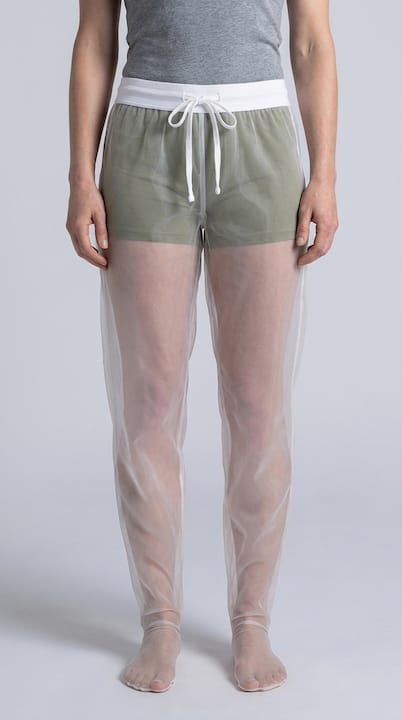
The situations where mesh pants outperform socks alone: seed-tick season in late summer, gardening in leaf litter, and any activity where you are crouching or sitting close to ground level. Those are exactly the exposures where larval crawl-through is most likely.
Why layered protection beats any single fix
The conventional wisdom in tick prevention tends to collapse into one recommendation: use permethrin, or tuck your pants, or check yourself after. Each of those is useful. None of them is enough on its own.
Permethrin-treated socks reduce lower-extremity bites, but the RCT evidence shows the effect on overall bite rates is modest. Tucking pants into socks works in theory, but behavioral research consistently shows people do not maintain the tuck through a full day of activity. Tick checks catch what everything else missed, but only if you do them thoroughly and know where to look.
The layered approach, clothing barrier plus treatment or mesh plus post-exposure check, compounds those individual effects. A tick that survives the physical barrier still has to survive the chemical treatment. A tick that survives both still has to survive the check. Each layer is imperfect. Together, they cover each other’s gaps.
The one thing I’d push back on is the idea that any single product or method makes tick protection “solved.” The research does not support that framing. What it supports is consistent, layered habits, and the clothing choices that make those habits easiest to maintain.
Zero chemicals, zero compromises with Bugawaygear
Permethrin works, but it comes with a reapplication schedule, label rules, and questions about use around children. If you want protection that is always on without the maintenance, Bugawaygear’s chemical-free mesh pants are the practical alternative.

The Bug Away Pants for Women and Bug Away Pants for Men use ultra-fine breathable mesh with integrated foot coverage, so the ankle gap that lets larval ticks through simply does not exist. Lightweight enough for summer hikes and garden sessions, eco-responsible materials, and a 30-day money-back guarantee. No sprays, no reapplication, no tucking that slips after 20 minutes. Browse both styles at Bugawaygear and see which fits your outdoor routine.
Sources
- Preventing Tick Bites - CDC
- The Effect of Long-lasting Permethrin Impregnated Socks on Tick Bite in Korea - PMC
- Tip #10: Keep tiny ticks from crawling through your socks – TickEncounter
- EPA – Insect repellents
- Do Ticks Wash Off in the Shower? - Dr. Daniel Cameron
This article is general information, not a substitute for advice from a qualified doctor. Consult a qualified healthcare professional about your own circumstances before acting on anything here.