
TL;DR:
- Chemical-free, tick-blocking mesh clothing provides a safe barrier for pregnant women without chemicals. Proper fit, layering, and trail behavior significantly enhance protection against ticks and Lyme disease. Combining physical barriers with careful checks and behavior reduces exposure and health risks effectively.
Yes, a pregnancy-safe option exists, and it doesn’t come in a bottle. Chemical-free, tick-blocking mesh clothing creates a physical barrier between your skin and ticks, with no chemical exposure risk for you or your baby. Experts recommend minimizing chemical exposure during pregnancy and focusing protection on physical barriers like long sleeves, long pants, and tightly woven fabrics. The single most actionable step: wear light-colored, full-coverage mesh, tuck pants into socks, and follow up with a full-body check after every outing.
A case-control study found protective clothing was approximately 40% effective at reducing Lyme disease risk in endemic areas. That’s a meaningful reduction, especially when you layer it with smart behavior and post-exposure checks.
- Wear long sleeves and long pants in light colors
- Tuck shirt into pants, pants into socks
- Stay on trail centers, away from brushy edges
- Shower within 2 hours and do a full-body tick check
- Launder and tumble dry outer clothing on high heat for 10 minutes
Table of Contents
- What’s your pregnancy-safe tick repellent checklist before, during, and after outdoor time?
- How does chemical-free mesh clothing actually protect you?
- How should you wear and layer mesh clothing during pregnancy?
- What behaviors multiply the protection from your clothing?
- How do you choose pregnancy-safe, chemical-free tick-proof clothing?
- How do you wash and store mesh clothing to keep it protective?
- When should you contact a healthcare provider after a tick bite?
- Which non-chemical ingredients are used in natural tick repellents?
- How do you apply natural repellents safely during pregnancy?
- How do you reduce tick presence in your yard?
- What are the tick-borne disease risks during pregnancy?
- How do you safely remove a tick when you’re pregnant?
- Key Takeaways
- Why chemical-free tick protection matters more than most people realize
- Bugawaygear’s chemical-free mesh clothing fits this checklist exactly
- Useful sources and further reading
What’s your pregnancy-safe tick repellent checklist before, during, and after outdoor time?
Before you head out
- Choose light-colored, full-coverage mesh or layered clothing sized to fit over your abdomen without pulling
- Pack a fine-tipped tweezer or tick removal kit and a small zip-lock bag
- Check local tick activity reports for your trail or park
During your outing
- Stay in the center of trails; avoid brushy edges and tall grass where ticks quest for hosts
- Tuck pants into socks and keep sleeves cuffed or secured at the wrist
- Wear closed-toe shoes and a hat if walking through wooded areas
- Do a quick visual scan of your clothing every 30 minutes
After you return
- Shower within 2 hours when possible to wash off unattached ticks
- Perform a head-to-toe tick check, paying close attention to ankles, behind the knees, under the bra line, around the waist, and the belly button
- Tumble dry outer clothing on high heat for 10 minutes to kill any hitchhiking ticks
- Store used outdoor clothing separately until laundered
Pro Tip: During pregnancy, waistbands that cinch tightly can create gaps at the hem and ankles as the fabric rides up. Size up and tuck rather than relying on a snug fit to seal the barrier.
How does chemical-free mesh clothing actually protect you?
Fine, tightly woven mesh works by denying ticks physical access to your skin. Ticks can’t bite through intact fabric, so a garment that covers all exposed skin and has no gaps eliminates the contact point entirely. It’s a mechanical solution, not a chemical one.
The NCBI case-control study showing roughly 40% effectiveness against Lyme disease used standard protective clothing, not specialized tick-proof mesh. Garments engineered with ultra-fine mesh and integrated closures at the ankle and wrist are designed to close the gaps that standard clothing leaves open.
CDC guidance consistently recommends minimizing exposed skin as a primary prevention strategy. Light-colored fabrics add a second layer of defense: ticks are dark and easy to spot against pale or sage-green fabric before they find an opening. That visual contrast gives you time to brush them off before they ever reach skin.
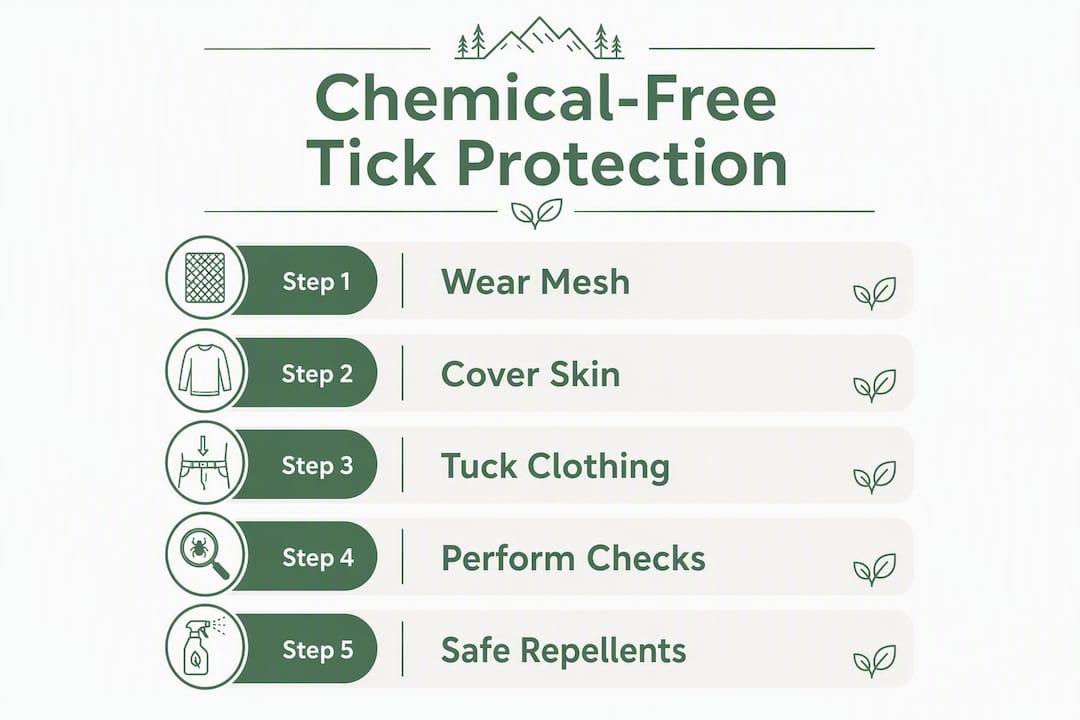
Physical barriers reduce risk substantially, but not to zero. Combine mesh clothing—which studies show is approximately 40% effective at reducing Lyme disease risk—with behavioral habits and post-exposure checks for the most complete protection.
How should you wear and layer mesh clothing during pregnancy?
Correct fit and layering matter more than the brand on the tag. A gap at the ankle or a hem that rides up over the belly defeats the purpose of the garment entirely.
- Choose breathable, stretch-accommodating options. Look for adjustable waists or elastic panels that fit over an expanding abdomen without pulling the hem up.
- Layer strategically. A lightweight moisture-wicking base layer under a loose outer mesh layer keeps airflow moving without compression over the belly.
- Tuck everything. Shirt into pants, pants into socks. Tucking pants into socks is the single highest-impact step for closing the ankle gap.
- Secure the wrists and neckline. Cuffed sleeves or wrist guards prevent ticks from crawling up the arm. A loose collar or open neckline is an entry point.
- Add a hat or head net when walking through tall grass or wooded areas.
Common pregnancy fit issues to watch for:
- Waistbands that ride down as the abdomen grows, pulling the shirt hem up and exposing skin
- Ankle hems that shorten as pants stretch across the hips
- Necklines that gap when bending forward
Pro Tip: Integrated foot coverage or lightweight gaiters eliminate the ankle gap more reliably than tall socks alone. The ankle is the most common failure point for physical tick protection.
When sizing, go one size up if you’re between sizes. A two-piece set lets you size the top and bottom independently, which is practical as your body changes through the second and third trimester.

What behaviors multiply the protection from your clothing?
Clothing is the foundation. Behavior is what makes it work.
Harvard Health and the CDC both point to trail behavior as a key variable in tick exposure. Ticks don’t jump or fly. They “quest” by climbing to the tips of grass blades and brush, waiting for a host to brush past. Walk down the center of a trail and you simply don’t make contact.
- Avoid sitting directly on logs, leaf litter, or ground cover in wooded areas
- Keep children and pets on the trail as well
- Do a visual clothing check every 30 minutes on longer hikes
Tick-check routine after returning home:
- Remove outer clothing at the door or in the garage
- Place outer layers directly into a bag for laundering
- Shower within 2 hours; the water helps dislodge unattached ticks
- Do a full-body check using a hand mirror or ask a partner to check hard-to-see spots: behind the ears, hairline, underarms, behind the knees, groin, and around the belly button
- Check your gear, bag, and shoes before bringing them inside
Consistent checks are your last line of defense. Ticks typically need to be attached for 36–48 hours before transmitting Lyme disease, so finding and removing one promptly matters.
How do you choose pregnancy-safe, chemical-free tick-proof clothing?
Prioritize coverage and adjustable fit over everything else. A garment that looks good but gaps at the ankle provides no protection.
Features to look for:
- Ultra-fine breathable mesh listed in the product specs
- Full-length sleeves and legs with secured cuffs
- Light-colored fabric for visual tick detection
- Adjustable or elastic waist that accommodates an expanding abdomen
- Integrated foot coverage or compatible gaiters
- Clear care instructions and washability
Trust signals worth verifying:
- 100% chemical-free materials claim with no insecticide treatment
- 30-day money-back guarantee
- Customer testimonial volume (Bugawaygear reports 500+ customer accounts of zero tick bites while wearing their products)
- Transparent sizing charts that show fit across different body shapes
When comparing options, generic outdoor pants and standard hiking gear are not designed to close the ankle and wrist gaps that tick-proof mesh addresses specifically. Look for garments built for tick prevention, not repurposed for it.
How do you wash and store mesh clothing to keep it protective?
Laundering correctly does two things: it preserves the mesh integrity and kills any ticks that may have hitched a ride home.
- Wash as directed on the garment label; most fine mesh performs best on a gentle or delicate cycle
- Tumble dry on high heat for 10 minutes after washing to kill ticks; if clothing is damp when you bring it in, add drying time before the heat cycle
- Inspect seams, drawcords, and ankle hems after every few washes; stretched or torn mesh at closures is the first sign a garment needs repair or replacement
- Store outdoor clothing separately from daily clothes in a sealed bag or bin until cleaned; don’t leave used gear in shared living areas
| Care Step | What It Does |
|---|---|
| Gentle machine wash | Removes dirt and surface debris without stressing mesh fibers |
| High-heat tumble dry (10 min) | Kills ticks on clothing per CDC guidance |
| Seam and hem inspection | Catches gaps before they become entry points |
| Separate storage until washed | Prevents ticks from migrating to other clothing or furniture |
When should you contact a healthcare provider after a tick bite?
Call your prenatal provider the same day if:
- The tick was attached for more than 24 hours, or you’re unsure how long it was attached
- You develop a fever, rash (especially an expanding red ring), or flu-like symptoms within 30 days of the bite
- The bite site shows spreading redness, swelling, or warmth
- The tick appeared engorged when you removed it
Document the date and time of removal, the bite location, and where you were when exposure likely occurred. Keep the tick in a sealed container if possible. Your provider may recommend testing or a short course of prophylactic antibiotics depending on the tick species, your location, and how long it was attached.
Most tick encounters don’t lead to infection. Early evaluation and prompt action when symptoms appear are what reduce risk most effectively.
Which non-chemical ingredients are used in natural tick repellents?
For pregnant people who want a secondary layer beyond clothing, a small number of plant-derived ingredients have been studied for tick-repellent properties. None replace physical barriers, but some are used as a supplementary measure.
- Oil of lemon eucalyptus (OLE): — Derived from the lemon eucalyptus tree, OLE has shown repellent activity in some studies. The CDC notes it should not be used on children under 3, and its safety profile during pregnancy has not been fully established. Consult your provider before use.
No essential oil-based product has the same evidence base as physical barrier clothing. Treat any natural spray as a supplement, not a substitute.
How do you apply natural repellents safely during pregnancy?
If your prenatal provider approves a plant-based repellent as a supplementary measure, a few application principles reduce unnecessary exposure:
- Apply to clothing rather than directly to skin when possible
- Avoid spraying near the face, mouth, or broken skin
- Apply in a well-ventilated area or outdoors
- Wash hands immediately after application
- Do not apply under clothing where absorption increases
- Check the full ingredient list; “natural” does not automatically mean safe during pregnancy
The safest approach remains physical barrier clothing as the primary protection, with any topical product used only after discussion with your provider.
How do you reduce tick presence in your yard?
Your yard can be a significant exposure zone, particularly in the Northeast, Mid-Atlantic, and upper Midwest where blacklegged ticks are common.
- Create a wood chip or gravel barrier (3 feet wide) between your lawn and wooded areas or leaf piles; ticks rarely cross dry, open surfaces
- Keep grass mowed short and remove leaf litter, brush, and wood piles where ticks shelter
- Move play equipment, seating, and garden beds away from wooded edges and into sunny, open areas
- Check pets after every outdoor outing; dogs and cats carry ticks indoors regularly
- Consider deer-resistant landscaping in high-tick areas, since deer are primary hosts for adult blacklegged ticks
Research on residential yard management shows that structural features like leaf litter accumulation and proximity to wooded edges are associated with higher larval tick abundance. Removing those features reduces the tick population near your home without any chemical application.
What are the tick-borne disease risks during pregnancy?
Lyme disease is the most common tick-borne illness in the United States, with the blacklegged tick as the primary vector in the Northeast and Midwest. Other tick-borne diseases include anaplasmosis, babesiosis, and Rocky Mountain spotted fever.
During pregnancy, some tick-borne infections carry elevated risk. Untreated Lyme disease during pregnancy has been associated in case reports with adverse outcomes, though the evidence base is still developing. Rocky Mountain spotted fever, caused by Rickettsia rickettsii, can be severe if untreated in any patient, including pregnant people.
The good news: prevention works. Physical barrier clothing, behavioral habits, and prompt tick removal together address the exposure pathway before infection can occur. Early treatment when a bite is identified also significantly reduces disease progression.
This article is general information, not medical advice. Confirm current guidance with your prenatal provider or a qualified clinician.
How do you safely remove a tick when you’re pregnant?
The removal process is the same regardless of pregnancy status, but the stakes of doing it correctly are higher.
- Use fine-tipped tweezers or a dedicated tick removal tool. Avoid using your fingers.
- Grasp the tick as close to the skin surface as possible. Don’t grab the body, which can squeeze fluids into the bite.
- Pull upward with steady, even pressure. Don’t twist or jerk.
- Clean the bite site with rubbing alcohol or soap and water immediately after removal.
- Place the tick in a sealed container or zip-lock bag with a damp paper towel; note the date and location of the bite.
- Call your prenatal provider if the tick was engorged, if you’re unsure how long it was attached, or if any symptoms develop.
Do not use petroleum jelly, nail polish, or heat to remove a tick. These methods are ineffective and may increase the risk of disease transmission.
Key Takeaways
Chemical-free mesh clothing combined with consistent tucking, trail behavior, and post-outing checks is the most practical pregnancy-safe tick prevention strategy available.
| Point | Details |
|---|---|
| Physical barrier is the foundation | Ultra-fine mesh clothing blocks tick access to skin without any chemical exposure. |
| Clothing ~40% effective in studies | A case-control study found protective clothing reduced Lyme disease risk by approximately 40%. |
| Tuck and check every time | Tuck pants into socks, shower within 2 hours, and do a full-body check after every outing. |
| Heat-dry outer layers | Tumble dry on high heat for 10 minutes to kill ticks on clothing per CDC guidance. |
| Bugawaygear for pregnancy fit | Bugawaygear’s 100% chemical-free mesh clothing with integrated foot coverage and adjustable fit is designed to meet this checklist. |
Why chemical-free tick protection matters more than most people realize
The conventional conversation about tick prevention during pregnancy almost always circles back to chemical repellents and whether they’re safe. That framing misses something. The question isn’t just “is this chemical safe enough?” It’s “why are we defaulting to chemicals when a physical barrier solves the same problem without the tradeoff?”
Mesh clothing doesn’t require a risk-benefit calculation. It doesn’t absorb into your skin, it doesn’t interact with anything, and it doesn’t require a conversation with your provider before every hike. You put it on, tuck it in, and the barrier is there. That simplicity is underrated, especially during a time when every product decision feels weighted.
The approximately 40% effectiveness figure from the NCBI study is often cited as a limitation. But that number reflects standard clothing, not purpose-built tick-proof mesh with sealed ankle closures and integrated foot coverage. The failure modes for standard clothing are well documented: gaps at the ankle, wrists, and neckline. Address those gaps and the protection improves substantially.
The other thing worth saying plainly: behavior matters as much as the garment. A tick-proof jacket worn with shorts and sandals is theater. The system works when every piece is in place.
Bugawaygear’s chemical-free mesh clothing fits this checklist exactly
Zero-chemical tick protection that actually covers all the bases is harder to find than it should be. Bugawaygear’s mesh clothing is built specifically for this: ultra-fine breathable mesh, integrated foot coverage to close the ankle gap, and sizing designed to fit over an expanding abdomen without compression.

The materials are 100% chemical-free, with no insecticide treatment and no synthetic repellent coating. Over 500 customers report zero tick bites while wearing the gear. Every order comes with a 30-day money-back guarantee, so fit and comfort can be tested in real conditions without risk.
Bug Away Women’s Pants are a strong starting point for pregnancy-friendly coverage, with adjustable waist options and full-length leg protection. The Bug Away Women’s Jacket pairs with them for complete upper-body coverage. View sizing details and order at bugawaygear.com.
Useful sources and further reading
- Preventing Tick Bites | CDC — Primary public-health guidance on clothing, behavior, and heat treatment for tick prevention
- Effectiveness of Personal Protective Measures to Prevent Lyme Disease | PMC/NCBI — Case-control study on protective clothing effectiveness (~40%)
- How to Avoid Ticks When You’re Pregnant | WebMD — Clinical guidance on physical barriers and chemical caution during pregnancy
- Preventing Tick Bites | Harvard Health — Practical dressing and behavior recommendations from Harvard Medical School
- Assessing Effectiveness of Residential Yard Management Against Ticks | PMC — Research on yard features and larval tick abundance
- Bug Away Blog | Tick Awareness & Insect Protection — Brand guidance on chemical-free tick prevention for families
- Insect Repellents | MotherToBaby — Fact sheet on insect repellent safety during pregnancy from a reproductive toxicology resource
Consult your prenatal provider before making any changes to your tick prevention approach during pregnancy.