
The most reliable non-toxic tick prevention combines three things: physical exclusion through tightly woven mesh clothing, landscape barriers that interrupt tick migration, and consistent behavioral habits like daily checks and heat-drying gear. Botanical sprays can reduce short-term risk, but their protection window is short and efficacy varies by tick species. Treat them as a backup, not a foundation.
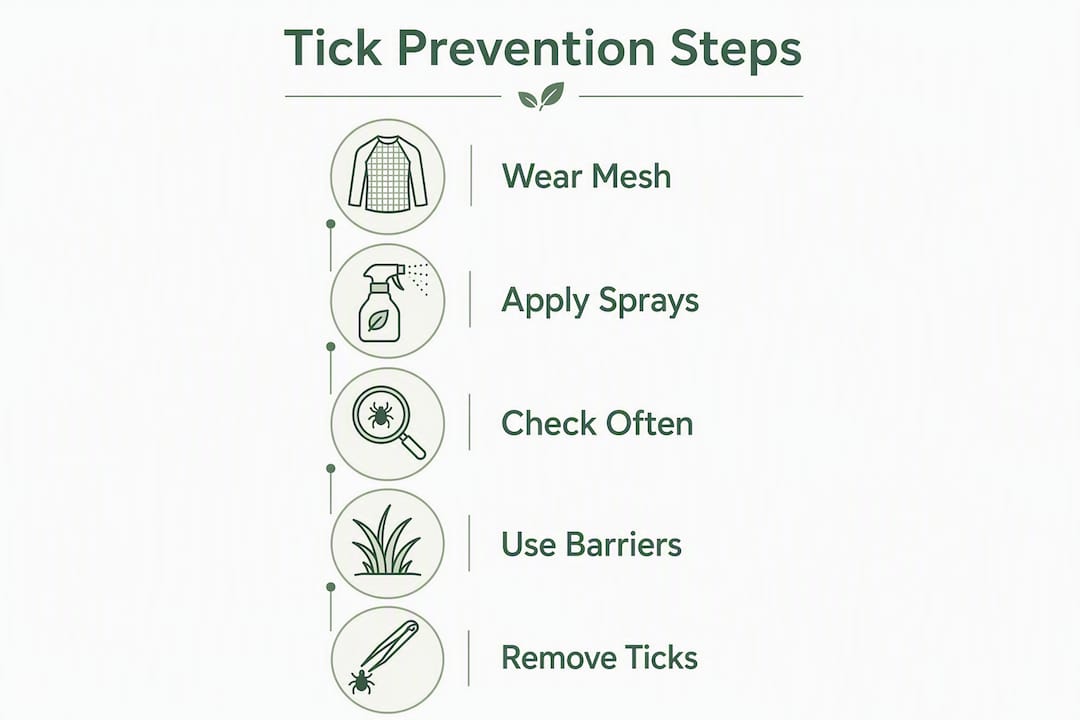
The core plan looks like this:
- Wear full-coverage mesh clothing with integrated foot coverage or tuck pants into socks before stepping outside.
- Build a 3-foot wood-chip or gravel barrier between your lawn and any wooded edges to block tick migration.
- Tuck pants into socks on every outing, even short ones in the backyard.
- Do a full-body tick check immediately after returning indoors.
- Dry clothes on high heat for 10 minutes to kill any ticks clinging to fabric.
Physical exclusion is the most direct form of tick prevention because ticks cannot fly or jump. They quest from low vegetation and wait for a host to brush past. Block that contact and you block the bite.
Botanical sprays like lemongrass or spearmint oil have shown tick-repellent activity in lab settings, but protection duration is short and results vary across species and formulations. Use them as a supplement if you choose, but never as your primary line of defense.
Table of Contents
- What’s your five-step checklist for safe outdoor time?
- How does non-toxic tick prevention actually work?
- How do you choose and wear physical-barrier clothing?
- What yard changes actually reduce tick numbers?
- Where do botanical sprays fit compared to EPA-registered repellents?
- How do you check for ticks and respond if you find one?
- What should you look for when buying non-toxic tick protection?
- Key Takeaways
- The case for starting with what you wear
- Bugawaygear makes the physical-barrier approach easy to act on
- Useful sources
What’s your five-step checklist for safe outdoor time?
A layered approach works better than any single tactic. CDC guidance consistently recommends combining barriers, repellents if used, checks, and habitat awareness.
Before you go:
- Dress in light-colored, full-coverage clothing so ticks are visible against the fabric.
- Tuck pants into socks or wear mesh pants with built-in ankle coverage. Here’s exactly how to tuck pants into socks for maximum protection.
- Apply an EPA-registered repellent if you want chemical backup; permethrin goes on clothing only, never skin.
During activity:
- Walk the center of trails and avoid brushing tall grass or shrubs.
- Check shoe tops and pant cuffs at rest breaks.
After you return:
- Run a full-body tick check from scalp to toes.
- Shower within two hours of coming indoors.
- Dry clothes on high heat for 10 minutes before bringing gear inside.
If you prefer fully chemical-free: prioritize mesh clothing and frequent checks. Reapply botanical sprays every hour or so if you use them at all.
Pro Tip: Pack a small tick-removal kit in your daypack: fine-point tweezers, antiseptic wipes, and a small sealed bag for any ticks you find. It takes up almost no space and matters a lot when you need it.
How does non-toxic tick prevention actually work?
Ticks do not fly, jump, or drop from trees. They quest, which means they climb low vegetation and extend their front legs to latch onto a passing host. That biology is the whole reason physical exclusion is so effective: if a tick cannot grip skin or loose fabric, it cannot attach.
Tightly woven mesh works by denying tick legs a surface to grip. Pair that with full coverage from ankle to collar, and you force any tick that lands on you onto visible fabric where it can be spotted and removed before it ever reaches skin.
Ticks typically need 36–48 hours of attachment to transmit Lyme disease bacteria. Removing them quickly, before they embed, is the most important thing you can do after physical barriers.
Landscape barriers work on a different principle. Ticks favor humid, shady microhabitats and follow host animals like mice and deer into yards. A 3-foot wood-chip or gravel barrier at the lawn-woods edge disrupts that migration path by creating a dry, exposed zone ticks avoid crossing. Regular mowing and leaf removal extend the same logic: less shade and moisture means fewer ticks surviving near your home.
Botanical repellents add a third layer, but a weaker one. Lab studies show lemongrass and spearmint oil can cause ticks to disengage in controlled conditions, but volatility means the protection evaporates quickly. That rapid evaporation is their core limitation: users often feel protected long after the active concentration has dropped below useful levels.
How do you choose and wear physical-barrier clothing?
Pick ultrafine mesh garments that cover every inch of skin from ankle to wrist. Light colors are practical, not just aesthetic: a dark tick on tan fabric is easy to spot. Integrated foot coverage or ankle cuffs matter more than most buyers realize, because ticks quest from low vegetation and the lower body is where most bites happen.
For fit, look for:
- Elastic or cinch cuffs at ankles and wrists that seal without bunching.
- A high-rise or adjustable waist so shirts can tuck in without gaps.
- Kids’ sizing with enough room for movement but no loose fabric that exposes skin at the waist or ankles.
- Machine-washable materials with reinforced seams at stress points.
For family outings, check that kids’ garments stay tucked during active play. A shirt that rides up on a running child creates exactly the gap ticks exploit. For high-risk areas, add a head net and consider gaiters over footwear.
Pro Tip: After washing, inspect seams and hems before the next outing. Integrated foot coverage in particular can loosen at the stitching over time. Catching it at home beats discovering it on the trail.

Explore clothing options for tick protection if you want a side-by-side look at mesh versus other approaches.
What yard changes actually reduce tick numbers?
Start with the basics before spending money on anything else. Remove leaf litter from yard edges, clear tall grasses and brush, and mow frequently. Stack firewood neatly away from the house and away from play areas. Move swing sets and sandboxes toward the center of the yard, away from wooded borders.
Then build the barrier:
- Mark a 3-foot-wide strip along the entire lawn-woods boundary.
- Clear all vegetation from that strip.
- Lay wood chips or gravel 3 feet wide and at least 2–3 inches deep.
- Maintain it seasonally: refresh chips in spring and clear any leaf accumulation in fall.
For lower-toxicity biological options, tick tubes (cotton treated with agents that target tick larvae on rodents) and beneficial nematodes applied to moist soil can reduce larval tick populations. Results vary, and local university extension services are the best source for guidance on what works in your region. Schedule a spring cleanup before peak tick season and a fall cleanup to eliminate overwintering habitat.
- Keep bird feeders away from the house to reduce rodent activity near the yard.
- Trim any vegetation that overhangs the wood-chip barrier.
- Check the barrier after heavy rain and redistribute material as needed.
Where do botanical sprays fit compared to EPA-registered repellents?
Botanical sprays can reduce tick engagement short-term, but they need frequent reapplication and their efficacy varies by tick species and oil concentration. That is the honest summary from both public-health guidance and the lab research on specific oils.
EPA-registered repellents, including DEET, picaridin, IR3535, and oil of lemon eucalyptus/PMD, have standardized testing behind them and known protection durations. Permethrin-treated clothing is effective and remains protective through several washings, but it is an insecticide applied to fabric. If you want to avoid pesticide-treated materials entirely, chemical-free mesh clothing is the cleaner alternative. Read more on permethrin clothing safety if you are weighing that tradeoff.
- Do not apply permethrin to skin under any circumstances.
- Botanical sprays for children: test a small area first and reapply every 60–90 minutes.
- Oil of lemon eucalyptus (OLE/PMD) is the one plant-derived option with EPA registration and meaningful tested efficacy.
Pro Tip: If you use any spray for kids, treat it as a supplement to physical barriers, not a replacement. Mesh clothing plus a spray is more reliable than either alone.
For a deeper look at bug spray alternatives, including what the research actually says about natural formulations, that resource covers the tradeoffs in detail.
How do you check for ticks and respond if you find one?
Check immediately after returning from any high-risk area. Do a full-body scan from scalp to toes, using a mirror for hard-to-see spots or asking a partner to check your back and scalp. Pay close attention to the scalp, behind the ears, armpits, groin, and behind the knees.
Safe removal steps:
- Use fine-point tweezers and grasp the tick as close to the skin surface as possible.
- Pull upward with steady, even pressure. Do not twist or jerk.
- Place the tick in a sealed bag or container.
- Clean the bite site and your hands with soap and water or antiseptic.
- Note the date and monitor for symptoms.
After removal:
- Watch for fever, expanding rash, or flu-like symptoms for 30 days.
- Contact a healthcare provider if symptoms develop or if you are in a high-risk Lyme area where post-exposure prophylaxis may be appropriate.
- Wash clothes and dry on high heat for 10 minutes before storing.
Never use heat, petroleum jelly, or nail polish to remove a tick. These methods can cause the tick to release fluids into the bite, which increases disease transmission risk.
What should you look for when buying non-toxic tick protection?
Product checklist:
- Ultrafine mesh with a weave dense enough to prevent tick legs from gripping.
- Full-coverage design with integrated foot coverage or compatible gaiters.
- Elastic or cinch closures at ankles, wrists, and waist.
- Available in kids’ sizes with adjustable fit.
- Machine-washable and durable through repeated washing.
- 30-day money-back guarantee and real customer testimonials describing outdoor use.
Questions to ask yard-service providers:
- Do you use pesticides, and if so, which ones?
- Do you offer non-chemical biological control options like nematodes or tick tubes?
- Can you document expected tick reduction and provide a maintenance schedule?
- Are your methods safe for children and pets immediately after application?
Prefer products with third-party verification or published testing data. A clear return policy and customer reviews describing real-world tick-free outings are stronger signals than marketing claims alone.
Key Takeaways
Physical exclusion combined with habitat controls and daily behavioral checks is the most reliable chemical-free approach to reducing tick risk for families and outdoor enthusiasts.
| Point | Details |
|---|---|
| Physical barriers first | Tightly woven mesh clothing that covers skin is the most reliable single non-toxic measure. |
| 3-foot yard barrier | A wood-chip or gravel strip at the lawn-woods edge interrupts tick migration into play areas. |
| Heat-dry after every outing | Ten minutes in a dryer on high heat kills ticks on clothing; washing alone is not enough. |
| Botanical sprays are secondary | Essential oils require frequent reapplication and have variable efficacy; treat them as a supplement. |
| Bugawaygear mesh clothing | chemical-free, ultrafine mesh pants and jackets with integrated foot coverage, backed by a 30-day guarantee and real customer testimonials |
The case for starting with what you wear
Most tick prevention advice leads with repellents and treats clothing as an afterthought. That order is backwards. Repellents, whether botanical or registered, require you to remember application timing, reapplication intervals, and correct coverage. Mesh clothing requires none of that. You put it on and it works for the entire outing.
The CDC’s guidance on physical exclusion and the research on botanical repellents’ volatility point to the same conclusion: a constant physical barrier outperforms an intermittent chemical one for families who are not going to reapply spray every hour on the trail. Yard controls reduce the baseline population near your home. Behavioral habits like daily checks catch what slips through.
The combination is not complicated. It is just less exciting to market than a spray bottle, which is probably why it gets less attention than it deserves.
Bugawaygear makes the physical-barrier approach easy to act on
Zero-chemical tick protection sounds straightforward until you try to find clothing that actually covers everything, fits kids, and holds up after a season of washing. Bugawaygear’s mesh pants and jackets are built specifically for that gap.

The Bug Away Pants for Women and Bug Away Pants for Men use ultrafine breathable mesh with integrated foot coverage, elastic ankle cuffs, and eco-responsible materials. No permethrin, no DEET, no chemical treatment of any kind. Over 500 customers report zero tick bites during outdoor use, and every order comes with a 30-day money-back guarantee. For families, the kids’ set covers the same sizing and coverage needs for younger hikers and backyard explorers. Browse the full range at bugawaygear.com and pick the set that fits your next outing.
Useful sources
- Preventing Tick Bites, CDC: primary guidance on physical exclusion, repellents, landscaping, and post-exposure steps
- Preventing Tick Bites, Harvard Lyme Disease Resource: clinical context on repellent types and tick-proofing strategies.
- Insect Repellent Safety, NYC Health: explains EPA registration and the difference between tested and untested repellents
- Botanical Repellents Review, PMC: peer-reviewed analysis of essential oil repellent duration and limitations
- Natural Tick Repellent Research, Daniel Cameron MD: lab findings on lemongrass, spearmint, and eucalyptus oils versus DEET.
- Bugawaygear, Chemical-Free Tick Protection: product range, sizing, and guarantee details.