TL;DR:
- Full-coverage ultra-fine mesh clothing provides the most reliable chemical-free protection against no-see-ums. A system that covers head to foot with tight seals effectively blocks the small insects that pass through standard netting.
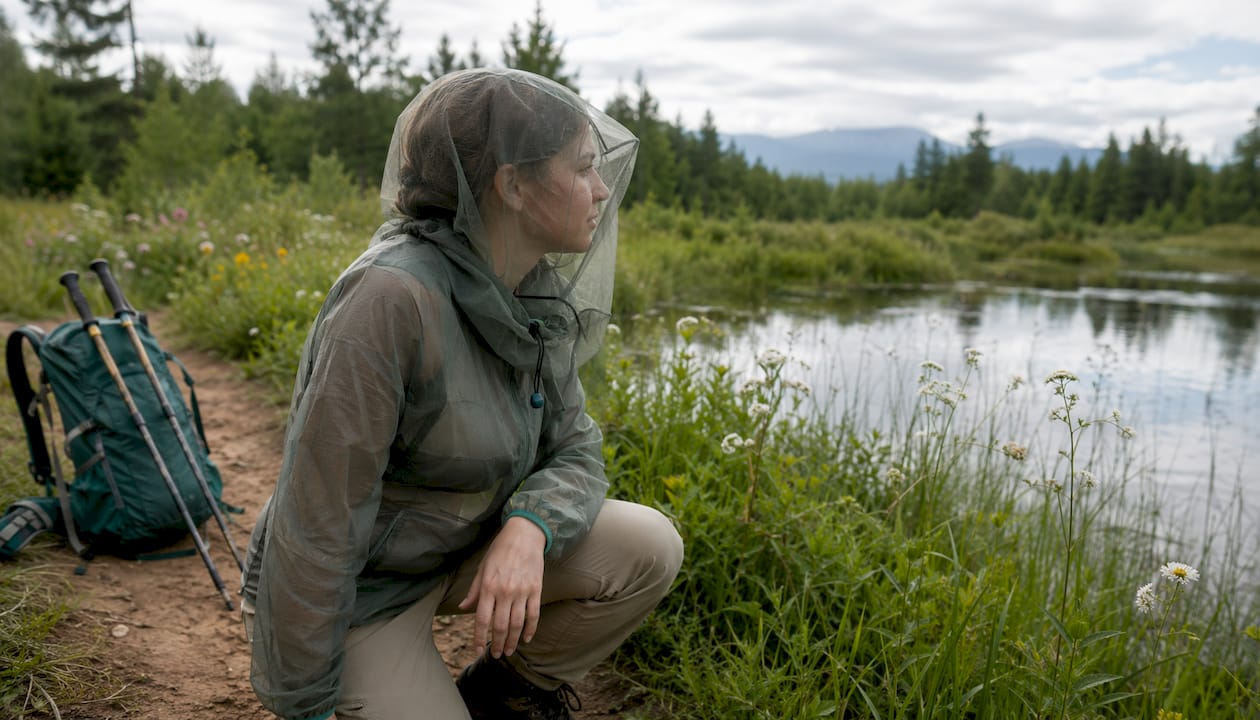
Full-coverage ultra-fine mesh clothing is the most reliable chemical-free defense against no-see-ums. The reason comes down to physics: biting midges are small enough to pass straight through standard mosquito netting, so only a fine enough weave stops them. A complete system covers head to foot, with no gaps at cuffs, ankles, or the neck.
The core elements of an effective system:
- A no-see-um head net with pores at or below 0.5 mm
- A long-sleeve mesh jacket with elastic or overlap cuffs
- Pants with integrated ankle or foot coverage
- Proper tucking and layering to seal every transition point
For hikers, gardeners, and families who want eco-responsible gear with low ongoing maintenance, this approach outperforms sprays and chemical treatments over the long run.
Table of Contents
- Why no-see-ums are harder to stop than mosquitoes
- How mesh actually blocks midges: the specs that matter
- What to look for when buying no-see-um protective clothing
- How to put on and secure your protection system in the field
- Care, durability, and what quality mesh clothing costs
- When mesh is enough — and when to add other measures
- Why Bugawaygear’s Bug Away pants fit this system
- Key Takeaways
- The case for committing to a system
- Bugawaygear’s Bug Away pants: where to get them
- Useful sources
Why no-see-ums are harder to stop than mosquitoes
No-see-ums (biting midges) are a fundamentally different problem from mosquitoes, and treating them the same way is where most people go wrong. Their bodies are small enough to pass through standard 16×16 or 20×20 mesh screens, which means the netting on most tents and screen doors offers little real protection.
Habitat and timing matter too. No-see-ums concentrate near shaded, humid edges — marsh borders, mangroves, wet dunes, and dense vegetation — and they are most aggressive at sunrise and sunset, or whenever the air goes still. A breezy open ridge? Manageable. A sheltered cove at dusk? A different situation entirely.
Key behavioral differences that change your protection strategy:
- Mosquitoes hunt by carbon dioxide plume over distance; midges swarm in localized clouds near their habitat edge
- No-see-ums are harder to feel landing, so bites often appear before you realize you are being attacked
- Standard repellents work less predictably on midges than on mosquitoes
The practical takeaway: protection must be physical, fine enough to stop smaller insects, and applied before you enter a risk area, not after the biting starts.
Stat: Standard mosquito mesh typically runs about sixteen to twenty holes per linear inch. Effective no-see-um mesh starts at a high holes per square inch count with pore sizes near 0.5 mm — a meaningful difference in weave density.
How mesh actually blocks midges: the specs that matter
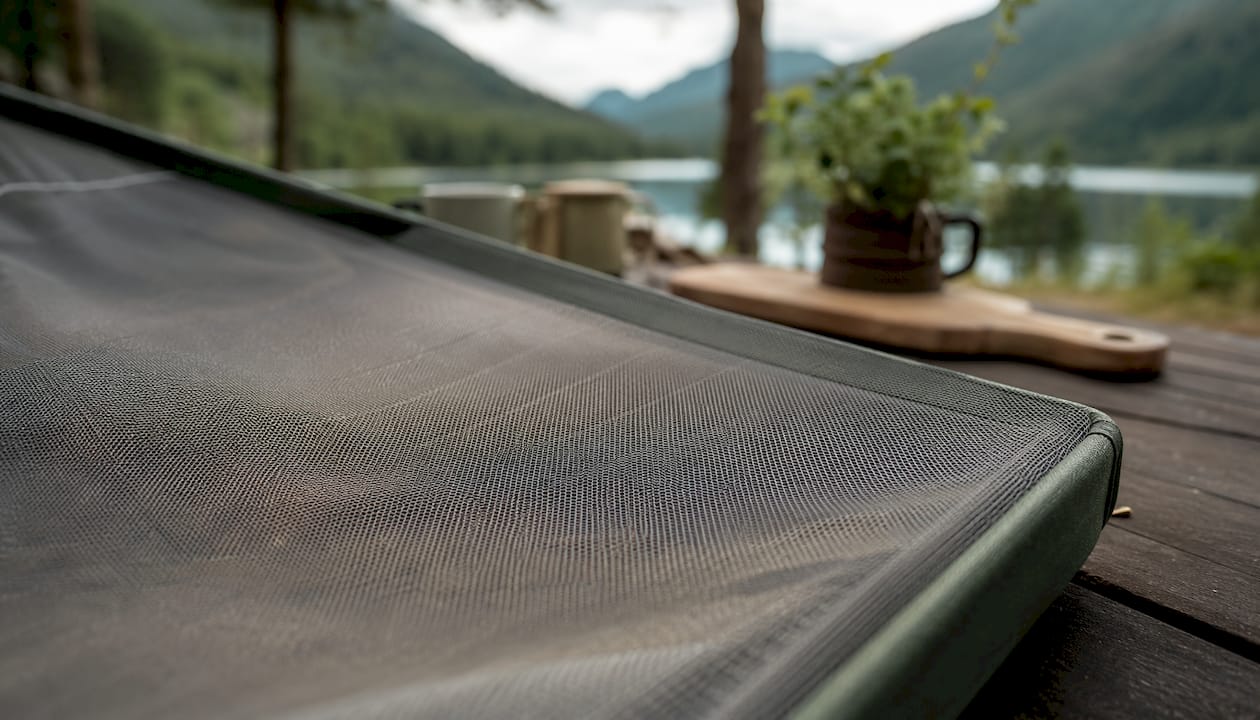
Mesh performance comes down to two numbers: hole count (holes per square inch) and pore size (millimeters). A midge’s body is small enough to squeeze through anything above roughly 0.5 mm, so that pore size is the practical ceiling for effective protection.
| Mesh Class | Hole Count | Pore Size | Typical Use |
|---|---|---|---|
| Standard mosquito mesh | 16–20 holes/in² | pore size over 1 mm | Window screens, basic nets |
| No-see-um mesh | 800 holes/in² or more | pore size near 0.5 mm | Clothing, curtains, enclosures |
| Ultra-fine head-net mesh | 1,600–2,000 holes/in² | pore size below 0.5 mm | Head nets, face protection |
Commercial head nets illustrate the range well. Coghlan’s offers a head net with very high hole density, while Sea to Summit’s ultra-fine model reaches a similarly high hole density. Ben’s UltraNet uses a 0.5 mm pore size as its stated protection threshold. Mid-range options like Snugpak’s head net have a relatively high hole count balancing durability and airflow for active use.
The airflow tradeoff is real but manageable. Denser weaves reduce air permeability, but manufacturers engineering for active outdoor use select lightweight yarns and open-knit structures that recover much of that breathability. A garment built for hiking at 800 holes/in² will feel different from a window screen at the same density.
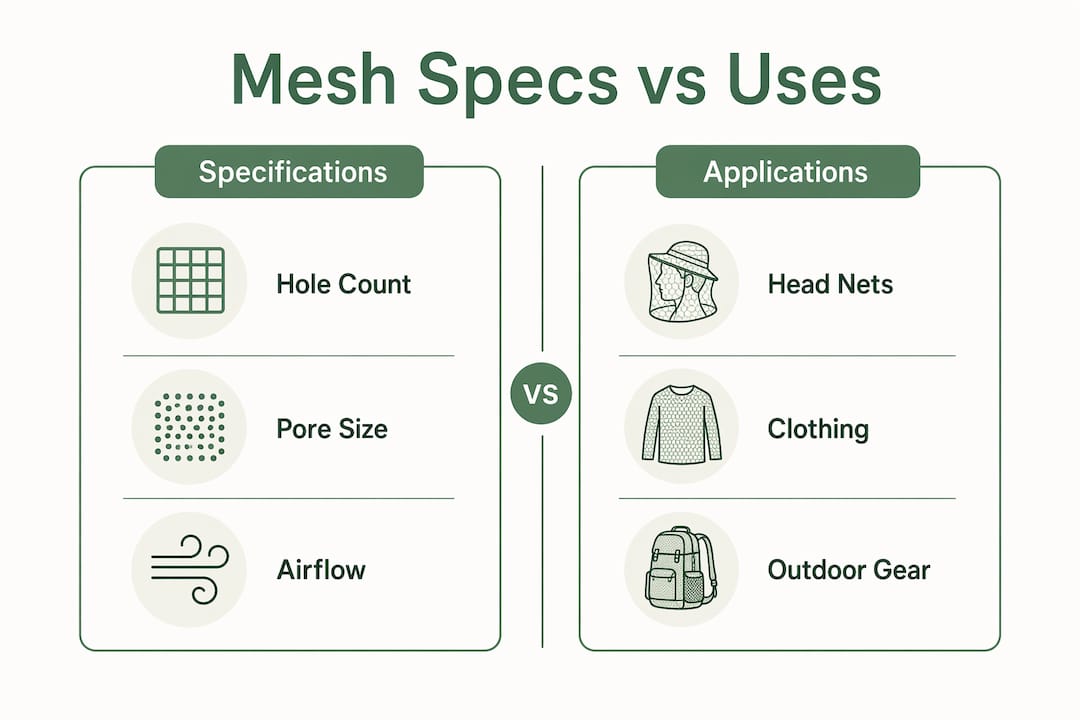
Pro Tip: Check the product label or spec sheet for actual hole count or pore size before buying. “No-see-um mesh” is a marketing term; the number tells you whether it actually qualifies.
What to look for when buying no-see-um protective clothing
Buying checklist for effective midge protection:
- Mesh density: 800 holes/in² minimum; 1,600–2,000 for head nets
- Full coverage design: integrated ankle or foot coverage, long sleeves, elastic or overlap cuffs
- Fit: snug enough at transition points (wrists, ankles, neck) to eliminate gaps without restricting movement
- Breathability: look for lightweight, high-density weaves engineered for active use, not just dense fabric
- Chemical-free materials: confirm no insecticide treatment if that matters to you
- Seam and closure quality: reinforced seams, zip or overlap closures at cuffs and ankles, hood compatibility
- Return policy: a 30-day money-back guarantee is the minimum worth considering
Pro Tip: Before a long outing, do a tuck-and-walk test at home: put the full system on, tuck everything, then crouch, reach overhead, and walk briskly. Any gap that opens under movement will open in the field.
How to put on and secure your protection system in the field
Getting the gear on correctly matters as much as buying the right gear. Gaps at cuffs, ankles, or the neck defeat even ultra-fine mesh.
- Start with base layers. Put on your regular clothing first; the mesh layer goes over it.
- Pre-treat if using a fabric-safe repellent. Apply to clothing before donning the mesh layer, not after. Proactive application before entering a risk area is more effective than reacting after bites appear.
- Put on the pants. Pull them fully up and tuck the hem into your socks or gaiters. No fabric bunching at the ankle.
- Secure ankle coverage. If the pants have integrated foot coverage, confirm it sits flat. With gaiters, overlap the pant hem by at least two inches.
- Put on the jacket. Zip fully. Tuck the jacket hem inside the pant waistband.
- Seal the wrists. Elastic cuffs should sit snug; if using hook-and-loop closures, press them flat.
- Add the head net last. Draw it over your hat, seat it on your shoulders, and confirm the drawcord is snug at the neck with no daylight showing.
- Do a partner check. Have someone scan your back, collar, and ankles before you step into a high-risk area.
For active use — hiking uphill, paddling, gardening in heat — you can loosen the jacket hem slightly for ventilation, but keep the cuffs and ankle seals closed.
Pro Tip: A small mirror is worth carrying. A 30-second self-check before entering a marsh edge or shaded dune takes less time than treating a dozen bites afterward.
Care, durability, and what quality mesh clothing costs
Quality no-see-um mesh clothing lasts multiple seasons with basic care. The fabric is the asset; protect it.
- Wash gently: cold water, delicate cycle, mild detergent. No bleach, no fabric softener, no high heat in the dryer.
- Inspect seams on arrival: reinforced stitching and flat-lock seams are signs of a garment built to last. Loose threads at cuffs or ankles are early failure points.
- Repair small tears immediately: a needle and thread in the field prevents a pinhole from becoming a gap. Mesh repair tape works as a temporary fix.
- Store folded, not crumpled: snags from rough storage degrade the weave over time.
Durability signals to check: yarn type (finer denier = lighter but inspect stitching carefully), seam construction at high-stress points (knees, cuffs), and closure quality.
On cost: disposable or budget mesh clothing tends to fail at seams within a season. A garment with a 30-day money-back guarantee signals the manufacturer stands behind the construction. That policy also makes the first purchase low-risk.
Note: Mesh clothing engineered for no-see-um protection is a category where solution-dyed and treated fabrics exist for specific applications — worth knowing when evaluating specialty options.
When mesh is enough — and when to add other measures
Mesh alone handles most situations well. Short outings at the beach, exposed ridgelines with a breeze, and daytime hikes in open terrain are all low-risk enough that a well-fitted mesh system is the whole answer.
A few situations call for additional steps:
- Dense infestations near standing water: add a portable fan to any seating area. No-see-ums struggle against airflow and will avoid it.
- Tent camping: check tent mesh for holes and use fine-mesh inserts if the built-in netting is standard mosquito grade.
- Enclosed or still-air spaces: site selection matters. Avoid setting up near marsh edges or shaded dunes at dusk when possible; a 50-yard move to open ground can cut exposure dramatically.
Non-chemical supplements worth using:
- Choose campsites on elevated, breezy ground
- Eliminate standing water near your site
- Avoid dark-colored clothing as an outer layer (it absorbs heat, which attracts midges)
- Run frequent self-checks for bites or ticks
When chemical repellents make sense as a supplement, apply them to clothing rather than skin where possible, test for sensitivity first, and follow the product label exactly. For guidance on avoiding and treating bites when they do occur, a healthcare provider is the right resource for severe reactions.
Pro Tip: Wearing light-colored outer layers reduces heat absorption and makes you less attractive to midges — a free upgrade that costs nothing.
Why Bugawaygear’s Bug Away pants fit this system
Bugawaygear builds its pants specifically for the chemical-free, full-coverage approach this article describes. Both the Bug Away Pants — Men and Bug Away Pants — Women use ultra-fine breathable mesh with integrated ankle and foot coverage, 100% chemical-free materials, and eco-responsible fabrication.
Key features:
- Ultra-fine mesh at specs designed to block biting midges
- Integrated ankle and foot coverage that eliminates the most common gap point
- 100% chemical-free construction, no insecticide treatment
- Lightweight and packable for day hikes, evening outings, and travel
Trust signals that matter here: over 500 customer testimonials report zero tick bites while wearing Bug Away gear, and the brand backs every purchase with a 30-day money-back guarantee.
The return policy makes the first order genuinely low-risk. Order your size, wear the system on a real outing, and return it within 30 days if it does not perform.
Key Takeaways
Full-coverage ultra-fine mesh clothing is the most reliable chemical-free defense against no-see-ums — the pore size stops midges that standard mosquito netting cannot.
| Point | Details |
|---|---|
| Mesh density is the deciding spec | Effective no-see-um mesh starts at 800 holes/in² with pore sizes near 0.5 mm; 1,600–2,000 holes/in² is typical for breathable head nets. |
| Gaps defeat even fine mesh | Seal cuffs, ankles, and the neck before entering any risk area. |
| Timing and site selection help | Avoid shaded, humid edges at dawn and dusk; choose breezy, elevated ground when possible. |
| Care extends garment life | Cold wash, no bleach, repair tears immediately, and store folded to protect the weave. |
| Bugawaygear’s Bug Away pants | Chemical-free, integrated ankle coverage, backed by 500+ testimonials and a 30-day guarantee. |
The case for committing to a system
The conventional wisdom on insect protection tends to treat every bug the same: spray something, hope for the best. No-see-ums expose exactly why that thinking fails. They are small enough to render standard gear useless, fast enough to bite before you feel them, and concentrated enough in specific habitats that a single gap in your coverage is all they need.
What actually works is a system mindset: the right mesh density, full coverage from head to foot, and the discipline to seal every transition point before you step into a risk area. The gear is only half of it. The other half is wearing it correctly, every time, not just when the bugs are already bad.
Chemical-free protection is not a compromise. For sustained outdoor use, it is the more practical choice: no skin sensitivity concerns, no reapplication schedule, no questions about what you are absorbing. A well-made mesh garment, cared for properly, outlasts dozens of spray cans and costs less over a season.
The one thing worth pushing back on is the idea that any single product solves this completely. Mesh clothing handles the majority of exposure. Site selection, timing, and fans handle the rest. Treat it as a layered approach, not a silver bullet, and you will stay comfortable in terrain that sends other hikers back to the trailhead.
Bugawaygear’s Bug Away pants: where to get them
Bugawaygear offers a direct path to the full-coverage, chemical-free system this article describes. The Bug Away Pants — Men and Bug Away Pants — Women are available now with sizing charts on the product pages. Every order comes with a 30-day money-back guarantee, so there is no risk in trying the system on a real outing before committing.
Check the sizing guide, order the pants that match your activity, and pack a light set for evening outings where midges are most active. Visit Bugawaygear for the full product range and brand information.
Useful sources
- Guide to No-See-Um Protection That Works — primary source for midge behavior, mesh specs, and system approach
- No-See-Um Mesh Fabric | Mosquito Curtains — mesh density, airflow tradeoffs, and fabric engineering
- Ultra-Fine Mesh Mosquito Bug Head Net | Sea to Summit — ultra-fine head net spec (310 holes/cm² / ~2,000 holes/in²)
- Ben’s UltraNet Head Net — 0.5 mm pore size benchmark for head net protection
- No-See-Um Head Net | Coghlan’s — commercial head net at 1,600 holes/in²
- Snugpak Head Net — mid-range spec at 784 holes/in² for active use
- Insect Repellents Fact Sheet | UNH Extension — authoritative overview of repellent chemistry and midge efficacy