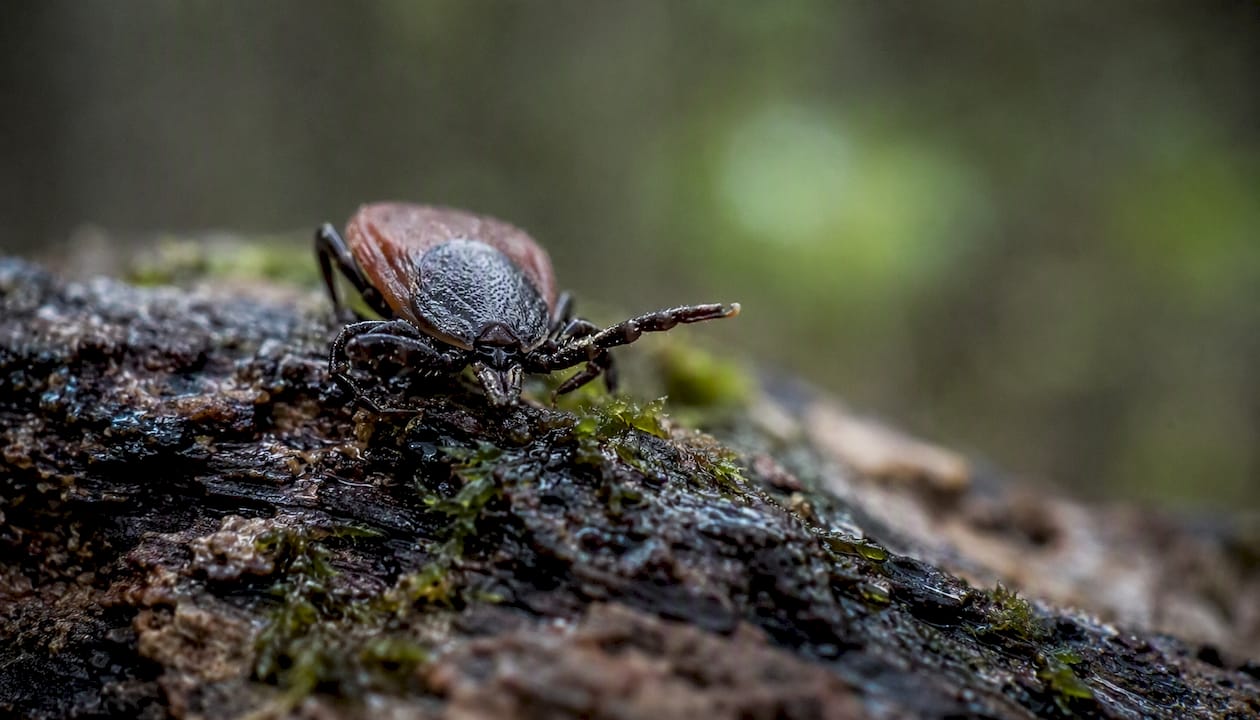
Ticks find you through smell, heat, and vibration, not sight. A tick’s Haller’s organ, a sensor cluster on its front legs, picks up the carbon dioxide in your breath, the odor of your skin, the moisture in the air around you, and even your body heat. Then it waits. Most ticks don’t chase you down. They practice what entomologists call questing, perching on grass or shrub tips with their front legs raised, ready to grab onto anything warm-blooded that brushes past.
That’s the whole mechanism in one paragraph. Here’s what matters for your next hike:
- Carbon dioxide and body odor draw a tick’s attention from several feet away, riding air currents toward your general location.
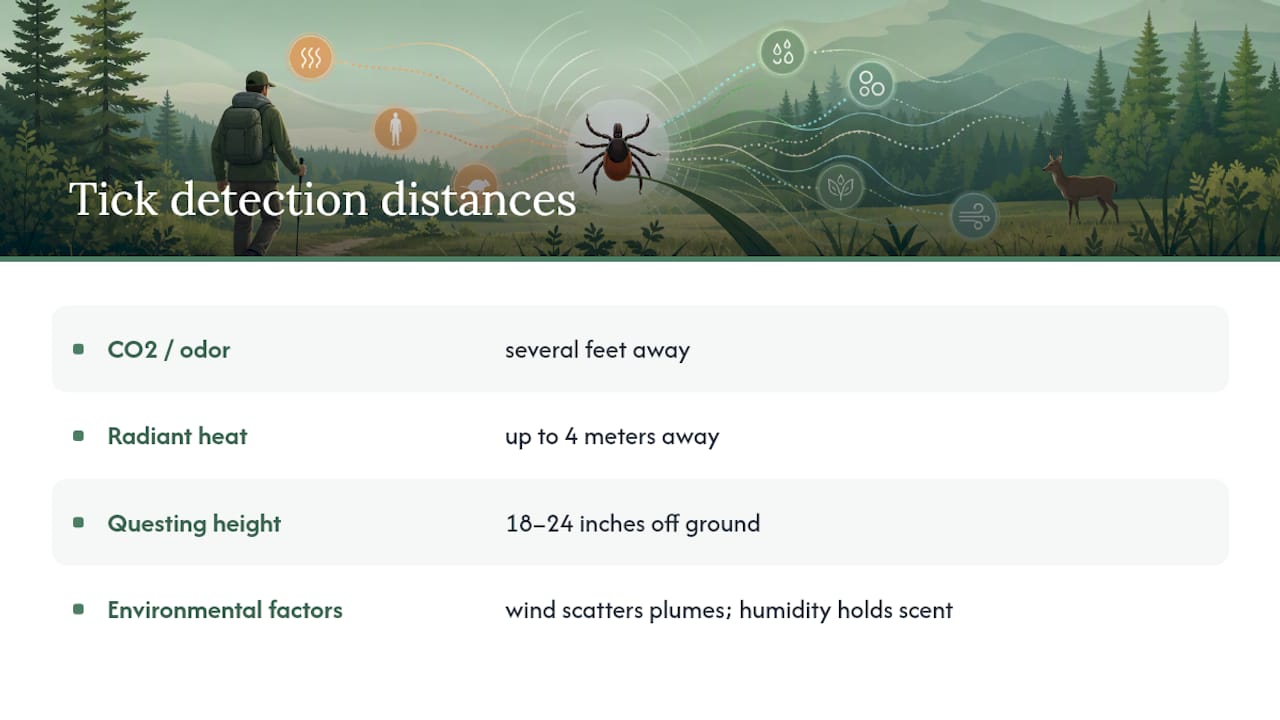
- Heat becomes detectable at closer range, and lab studies show some species can sense it from as far as 4 meters under ideal conditions.
- Moisture and vibration help a questing tick judge exactly when something living is close enough to grab.
- Vision plays almost no role. Ticks don’t have image-forming eyes worth mentioning, so they’re not spotting you across a meadow.
None of this means ticks are hunting you like a mosquito circles a porch light. They can’t fly or jump. A tick gets on you because you walked into its ambush zone, not because it launched itself at you. That single fact reshapes almost every practical decision about prevention, from where you walk to what you wear.
Key Takeaways
Ticks locate hosts through Haller’s organ, which senses carbon dioxide, body odor, heat, and moisture, then rely on ambush contact rather than pursuit to attach.
| Point | Details |
|---|---|
| Haller’s organ drives detection | This foreleg sensor reads CO2, odor, heat, humidity, and vibration to confirm a host is close. |
| Ticks don’t jump or fly | They attach only through direct contact when you or your pet brushes against their perch. |
| Timing decides disease risk | Removing an attached tick within about 36 hours substantially lowers Lyme disease risk in many settings. |
| Layer your prevention | Combine trail discipline, repellents, and full-body checks since no single method blocks every sensory cue. |
| Physical barriers stop contact outright | Bug Away’s mesh pants for men and women block ticks from reaching skin without any chemical treatment. |
Table of Contents
- How Ticks Sense You: Haller’s Organ and the Cues That Matter
- Do Ticks Hunt or Wait? Questing vs. Active Pursuit
- How Far Away Can a Tick Actually Detect You?
- What Happens Once a Tick Gets on You
- Why Attachment Time Determines Your Disease Risk
- What Actually Keeps Ticks Off You
- Common Tick Myths That Won’t Die
- What Understanding Tick Senses Actually Changes
- A Chemical-Free Way to Block Ticks Before They Reach Skin
- Frequently Asked Questions
- Sources
How Ticks Sense You: Haller’s Organ and the Cues That Matter
Every tick’s most important sensory tool sits on the tips of its front legs, tucked into a small pit called Haller’s organ. It’s not one sense. It’s several packed into a single structure, doing the job that your nose, skin, and inner ear do separately.
Haller’s organ handles chemosensation (smelling carbon dioxide and skin compounds), hygrosensation (reading humidity), and thermosensation (detecting heat). Entomology reviews describe ticks as patient ambush predators that rely on this multimodal input to confirm a host is close enough to be worth the energy of grabbing on. A tick doesn’t waste its one shot at a meal on a false alarm.
Each cue does a different job in the detection sequence:
| Cue | Sensory channel | What it tells the tick |
|---|---|---|
| Carbon dioxide (breath) | Chemosensory receptors in Haller’s organ | A warm-blooded animal is somewhere nearby |
| Body odor (skin compounds) | Olfactory receptors | Confirms host type and helps with orientation |
| Radiant heat | Thermoreceptors in the Haller’s organ capsule | Precise direction and proximity of a host |
| Humidity/moisture | Hygroreceptors | Local microclimate suitable for tick survival |
| Vibration | Mechanoreceptors | Movement of a potential host through vegetation |
| Light/shadow | Simple photoreceptors (limited species) | General day/night and shade cues, not detailed vision |
The heat-sensing piece is the most surprising part for most people. Laboratory thermotaxis assays found that the posterior capsule of Haller’s organ works like a directional infrared sensor. In one set of experiments, Amblyomma americanum females detected a small heated plate warmed to human skin temperature from at least a meter away, and under ideal conditions from as far as roughly 4 meters.
That heat-detection distance is a lab result under controlled airflow, not a guarantee of what happens on a windy trail. Real-world conditions, moving air, scattered vegetation, and competing heat sources all shrink that effective range. But it explains why standing still near a shrub line doesn’t make you invisible. Questing ticks typically hold position 18 to 24 inches above the ground, which happens to line up with where your calves, ankles, and shins brush against roadside brush.
This is also why some repellents work the way they do. Compounds like DEET and picaridin don’t kill a tick’s ability to smell you. They scramble its heat-sensing pathway, and in lab assays even low concentrations of certain compounds eliminated thermotaxis without shutting down its response to odor. The tick still knows something is out there. It just loses the precision needed to close the distance.
Do Ticks Hunt or Wait? Questing vs. Active Pursuit
Most ticks don’t hunt in any sense you’d recognize. They quest, which means climbing to the tip of a grass blade or low shrub, extending their front legs, and waiting for something to walk by. A questing tick can hold that exact posture for days, conserving energy until a host brushes the vegetation and gives it a ride.
A smaller number of species take a more active approach, sometimes called hunting behavior, where they move toward stimuli rather than sitting still for them.
- Questing species position themselves at leg height on vegetation and rely almost entirely on passive contact. Ixodes scapularis, the blacklegged tick behind most Lyme disease cases in the eastern United States, is a classic quester.
- More active species, like Amblyomma americanum (the lone star tick), show a stronger tendency to move toward a detected host once cues are strong enough, closing gaps that a purely passive tick would leave alone.
- Species behavior varies by region and life stage. A nymph and an adult of the same species don’t always behave identically, and local populations can shift strategy based on habitat density.
- Encounter risk follows behavior. Questing ticks concentrate along trail edges and waist-to-knee-height brush; more mobile species can show up slightly farther from the exact point of contact.
Neither strategy involves jumping, dropping, or flying. Both require a tick to already be positioned somewhere your body, or your dog’s, will physically touch.
How Far Away Can a Tick Actually Detect You?
“Detect” and “attach” are two different things, and mixing them up is where most tick myths come from. A tick can pick up a whiff of carbon dioxide from several feet away without being anywhere close to grabbing onto you.
Long-range cues travel on air movement. CO2 and skin odor compounds drift with wind currents, sometimes reaching a tick well before you’re anywhere near its perch. Short-range cues work differently. Radiant heat only becomes useful once you’re within a few feet, since it requires a fairly direct thermal signal hitting the Haller’s organ capsule.
Under tightly controlled lab airflow, some ticks detected human-equivalent radiant heat from up to 4 meters away, while questing height itself sits around 18 to 24 inches off the ground. Those two numbers together explain a lot about where bites happen. A tick doesn’t need to sense you from far off. It needs to be sitting at exactly the height your leg will pass, close enough that heat and vibration confirm contact is imminent.
Wind scatters odor plumes and can either help a tick detect you sooner or blow the signal away from its perch entirely. Dense humidity holds scent closer to the ground, which is part of why tick activity often spikes on humid, still mornings. Thick vegetation increases the odds that some part of your body brushes a questing tick regardless of how good or bad its detection range is that day.
This is the real argument for staying in the center of a trail instead of walking the edges. It’s not about outrunning a tick’s senses. It’s about denying it the physical contact it needs no matter how well it detected you coming.
What Happens Once a Tick Gets on You
Getting on you and biting you aren’t the same event, and the gap between them is your best chance to intervene. Many ticks don’t bite immediately. They crawl, sometimes for an hour or more, searching for skin that’s thin, warm, and reasonably protected from being brushed off.
That search usually ends somewhere you don’t check often: the hairline, behind the ears, the armpits, the groin, the waistband, or the backs of the knees. Once a tick settles in, it inserts a barbed feeding structure into the skin and can remain attached, feeding slowly, for several days if left undisturbed.
Removing one correctly matters more than people assume.
- Grab the tick as close to the skin as possible using fine-tipped tweezers or a dedicated tick removal tool.
- Pull upward with slow, steady pressure. Don’t twist or jerk.
- Clean the bite area and your hands with rubbing alcohol or soap and water.
- If you want it identified or tested, save the tick in a sealed bag with the date.
A few things you should never do: don’t smother a tick in petroleum jelly, don’t try to burn it off, and don’t twist it out. All three tend to make an attached tick regurgitate into the bite, which can raise infection risk instead of lowering it. If a rash, fever, or flu-like symptoms show up in the days or weeks after a bite, that’s a reason to call a clinician, not wait it out.
Why Attachment Time Determines Your Disease Risk
The clock matters more than the bite itself. Disease transmission risk generally climbs the longer a tick stays attached, and most pathogens need a window of feeding time before they move from the tick into your bloodstream in meaningful amounts.
A tick can spend 10 minutes to two hours just picking a feeding site before it ever bites. That crawling period is pure opportunity for you, assuming you’re actually checking.
| Timeframe | What’s happening | Why it matters |
|---|---|---|
| 10 minutes to 2 hours | Tick is crawling and choosing a feeding site | Prime window to spot and remove it before any bite occurs |
| First several hours after attachment | Feeding begins slowly | Lower transmission risk for most pathogens at this stage |
| Roughly 36 hours attached | Extended feeding | Removal within about 36 hours substantially lowers Lyme disease risk in many settings |
| Multiple days attached | Full feeding cycle | Highest risk window; species and pathogen determine exact transmission speed |
Removing an attached tick within roughly 36 hours meaningfully cuts your Lyme disease risk in many cases, though exact windows shift by species and pathogen. That’s the single most actionable number in this whole topic. It’s also why a five-minute post-hike check beats any repellent, clothing, or yard treatment on its own. None of those prevention layers matter if a tick attaches and goes unnoticed for three days.
If you develop a rash (especially one that expands or forms a bull’s-eye pattern), joint pain, or unexplained fever after a bite, contact a clinician. This is general information, not a substitute for medical advice, and testing or treatment decisions belong with a healthcare provider familiar with your case.
What Actually Keeps Ticks Off You
Prevention works best in layers, and the layers should target the specific senses ticks rely on. Trying to beat a multimodal sensor with a single tactic is why so many people still get bitten despite doing “something” right.
- Stay off the vegetation edges. Walking the center of a trail avoids most questing ticks, since they can only grab you through direct contact.
- Wear tightly woven or fine mesh clothing that physically blocks legs from reaching skin, and tuck pants into socks at the ankle.
- Choose light-colored gear so a crawling tick stands out against fabric during a quick visual check.
- Use repellents on skin or treated clothing to interfere with a tick’s chemical and thermal detection, understanding that this reduces rather than eliminates contact risk.
- Keep your yard mowed and clear leaf litter, since ticks need humidity and cover to survive between hosts.
- Check pets after outdoor time, since they can carry ticks into the house long after your own walk is over.
Physical-barrier clothing solves a different problem than repellents do. A repellent tries to confuse the tick’s senses. A woven or mesh barrier makes the sensing irrelevant, because the tick’s legs simply can’t get through the fabric to reach skin. Bug Away Pants for men and Bug Away Pants for women work on that mechanical principle, using a fine mesh weave with no insecticide treatment involved.
Pro Tip: Tumble-drying clothes on high heat for ten minutes after a hike kills any ticks riding along, even ones you never spotted during a visual check.
Common Tick Myths That Won’t Die
A surprising number of widely repeated tick “facts” don’t hold up once you look at how these arthropods actually operate. A few are worth killing off directly.
- “Ticks drop out of trees onto your head.” They don’t. Questing ticks sit on low vegetation, typically 18 to 24 inches off the ground, and rely on brushing contact, not gravity. A tick dropping from a tree canopy has no way to guide its fall toward a moving target.
- “Ticks jump or fly to reach you.” Their anatomy doesn’t support either. Ticks have no wings and no jumping legs built for propulsion. Every attachment happens through direct contact when a host brushes against the spot where a tick is already waiting.
- “Heat detection is a myth, ticks only smell you.” Recent thermotaxis research contradicts this directly, showing that Haller’s organ functions as a genuine directional heat sensor in addition to a chemical one.
Occluding the posterior capsule of Haller’s organ in lab experiments eliminated a tick’s ability to orient toward a heat source entirely, confirming that this structure works as a dedicated directional thermal sensor rather than a secondary backup to smell.
That finding, drawn from thermotaxis research on Haller’s organ function, matters because it explains why disrupting just one sense with a repellent doesn’t always stop a tick cold. Because the organ combines multiple independent senses, a tick that loses its heat perception can sometimes still track you by smell alone, which is exactly why layered protection outperforms any single method.
What Understanding Tick Senses Actually Changes
Most tick advice treats prevention like a checklist, spray here, tuck pants there, without explaining why any of it works. Once you understand that a tick’s entire strategy rests on ambush and multimodal sensing rather than active hunting, some of the standard advice starts to look incomplete.
Repellents get marketed as a complete solution, but the research on thermotaxis disruption tells a more honest story: they interfere with one sensory channel, not all of them. A tick that loses its heat-tracking ability can often still orient using odor. That’s not a reason to skip repellents. It’s a reason to stop treating them as sufficient on their own. Physical barriers close the gap that chemistry leaves open, because a mesh weave doesn’t need to fool a sensor. It just needs to keep legs off skin. Combining a mechanical barrier with a repellent, sensible trail behavior, and a genuine post-hike check covers the sensory bases that any single method leaves exposed.
The biggest blind spot I see is the assumption that if you didn’t feel anything, nothing happened. Tick bites are painless by design. The crawling period before a bite can run past an hour, and the feeding period afterward can run for days. None of it registers as a sensation you’d notice without looking. That’s the actual argument for building tick checks into your routine the same way you’d check for a sunburn, not something to remember only after you notice a bite.
A Chemical-Free Way to Block Ticks Before They Reach Skin
Repellents fight tick senses; mesh clothing skips the fight entirely by keeping legs off skin in the first place. Bug Away’s mesh pants use an ultra-fine weave that blocks a tick’s legs from ever reaching your skin, no matter how well its Haller’s organ tracked you there.

The men’s pants and women’s pants are built with the same chemical-free mesh, so there’s nothing to reapply, wash off, or worry about around kids or pets. That makes them a natural complement to repellents rather than a replacement, and Bug Away backs every order with a 30-day money-back guarantee if the fit or feel isn’t right for your trail.
Clothing reduces contact risk. It doesn’t erase it entirely, so pair it with the tick checks and prompt removal covered earlier in this guide. If you’re heading out for a hike, a garden session, or a weekend of yard work, browse the men’s or women’s pants and pick your size before your next trip outdoors.

Frequently Asked Questions
How do ticks find you if they can’t see well? They rely on smell, heat, and moisture instead of vision. Carbon dioxide and skin odor draw initial attention, while Haller’s organ’s heat sensors help confirm proximity once you’re within a few feet.
Do ticks jump onto people from grass or trees? No. Ticks have no jumping or flying anatomy. They quest on low vegetation and attach only through direct contact when a host brushes against them.
How close does a tick need to be to detect body heat? Lab studies found some species can detect human-equivalent radiant heat from up to roughly 4 meters under ideal, controlled conditions, though real-world wind and vegetation typically shrink that range.
Does bug spray stop ticks from finding you completely? Not entirely. Repellents disrupt heat-based tracking in many cases but don’t always block odor-based detection, which is why pairing repellents with physical-barrier clothing covers more sensory ground.
How long can a tick be attached before it’s dangerous? Risk rises with time. Removing an attached tick within about 36 hours substantially cuts Lyme disease risk in many settings, though exact windows vary by pathogen and species.
Sources
The claims in this guide draw from public-health guidance and peer-reviewed entomology research, not general blog consensus.
- About Ticks and Tickborne Disease
- Host detection by ticks (review)
- Guide to different tick species and the diseases they carry - Mayo Clinic