
TL;DR:
- Physical barrier clothing with sealed cuffs and integrated foot coverage offers the most reliable chemical-free tick protection. Treating socks and lower pant cuffs with plant oils like oregano or spearmint can enhance defense, especially in low-risk environments. For high exposure areas, combining physical barriers with EPA-registered repellents provides the most effective protection.
The most reliable approach to chemical-free tick protection combines three layers: physical-barrier clothing (like Bugawaygear’s ultra-fine mesh pants and jackets), targeted textile treatments using evidence-backed plant oils, and consistent behavioral and yard controls. Together, these give most U.S. outdoor enthusiasts solid protection without a single synthetic chemical.
This weekend, start here:
- Pull on sealed-cuff pants or tuck your pants into socks before heading out
- Apply a diluted oregano or spearmint oil formulation to your socks and lower pant legs
- Do a full-body tick check within two hours of coming inside
The honest tradeoff: Chemical-free methods work well for most low-to-moderate exposure situations. In dense tick habitat during peak season, or when you’re out for hours in known Lyme-endemic areas, EPA-registered repellents or permethrin-treated clothing may offer more consistent protection. Know your environment and layer accordingly.
Table of Contents
- Why do ticks target your lower body first?
- Does physical-barrier clothing actually stop ticks?
- Can plant oils on clothing actually repel ticks?
- What personal habits and yard changes reduce tick encounters?
- When are chemical repellents still the smarter choice?
- How do you remove a tick safely?
- Your three-step chemical-free plan for this weekend
- Key Takeaways
- Why physical barriers are the right foundation
- Bugawaygear gives you a chemical-free layer that doesn’t depend on reapplication
- Useful sources and further reading
Why do ticks target your lower body first?
Ticks don’t fly or jump. They wait on low vegetation, typically grass blades and leaf litter below knee height, and latch onto a passing host by contact. That behavior, called questing, means your socks, shoes, and lower legs are the highest-risk entry points on your body. Protecting them first is not a stylistic choice — it’s biology.
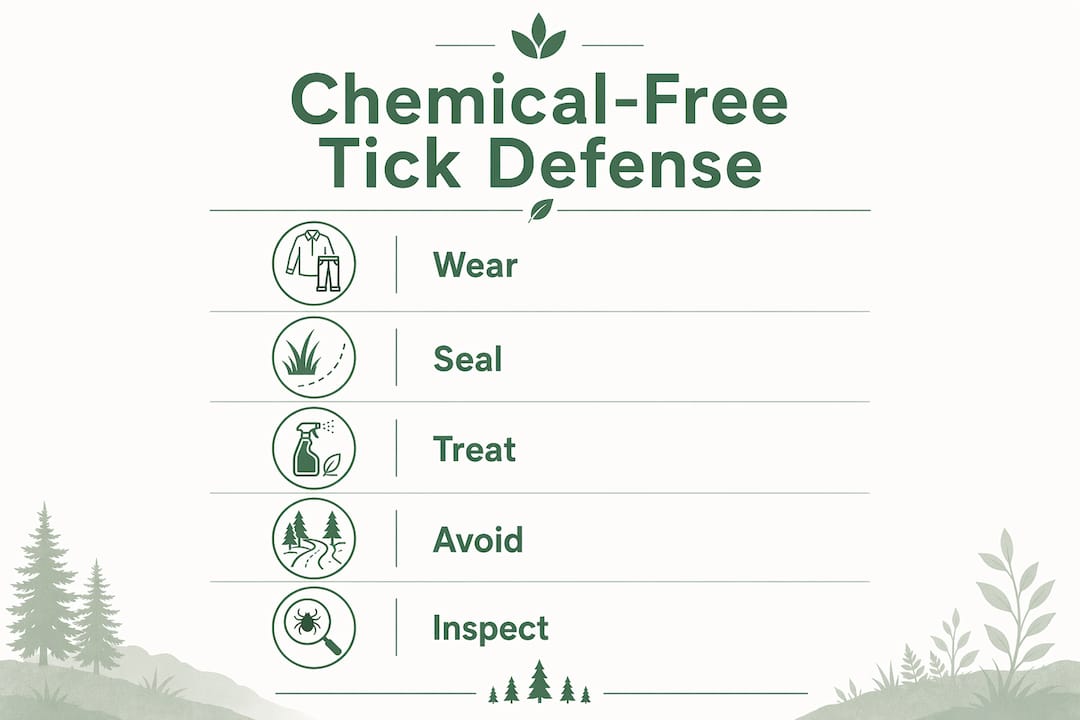
The Lone Star tick (Amblyomma americanum) is one of the most aggressive human-biting ticks in the U.S., and it’s expanding its range across the Southeast and Midwest. The black-legged tick (Ixodes scapularis), which vectors Lyme disease, is similarly ground-level in its approach. Both species are most likely to reach you from the ankle up.
That insight shapes every effective defense: sealed cuffs, integrated foot coverage, and targeted lower-leg treatments all address the actual point of entry. Spraying your shirt collar and ignoring your socks is backwards.
Does physical-barrier clothing actually stop ticks?
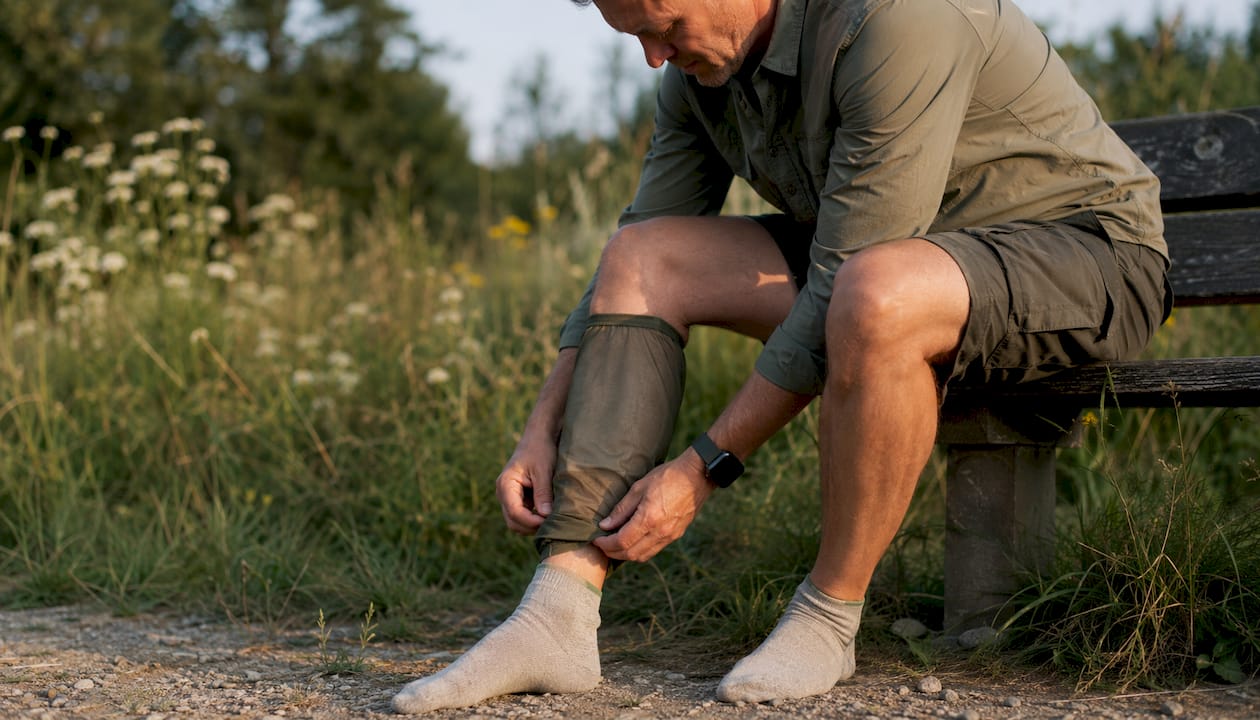
Yes, and it’s the most consistent chemical-free defense available for high-tick situations. A well-designed mesh garment with sealed cuffs and integrated foot coverage physically prevents ticks from reaching skin — no chemistry required, no reapplication schedule, no degradation in rain.
When shopping for barrier clothing, look for:
- Ultra-fine breathable mesh that blocks tick legs without trapping heat
- Sealed or elasticized cuffs at the ankle and wrist to close the most common entry gaps
- Integrated foot coverage or built-in gaiters that eliminate the sock gap entirely
- Durable seams that hold up to repeated washing without gaps forming
- Sizing for the whole family, including kids, since a loose adult fit on a child leaves gaps at the ankle
Bugawaygear’s Bug Away Pants — Men and Bug Away Pants — Women are built around exactly these features: ultra-fine mesh construction, integrated foot coverage, and 100% chemical-free materials backed by a 30-day money-back guarantee. Over 500 customers report zero tick bites while wearing them. For families, the pants layer easily over base layers in cooler weather and breathe well enough for summer hiking.
Pro Tip: Pair Bug Away pants with a diluted plant-oil treatment on your socks for a two-layer defense at the ankle — the most common tick entry point. The mesh handles the climb; the oil adds a contact deterrent at the base.
Can plant oils on clothing actually repel ticks?
The short answer is yes, with caveats. A peer-reviewed study on essential oils and tick repellency found that treating textiles with certain oils, including oregano and spearmint, significantly reduced tick acquisition. Oils like cinnamon, clove, and geraniol provided complete protection times exceeding one hour in contact assays, and the repellency held over a 24-hour interval after initial application. That’s a meaningful result for a day hike.
How to treat textiles safely:
- Dilute your chosen essential oil in a carrier (water or isopropyl alcohol) per product label guidance — never apply undiluted oil directly to fabric or skin
- Spray or dab onto socks, lower pant cuffs, and shoe uppers only
- Allow to dry fully before wearing
- Reapply after washing or after roughly 8 hours of outdoor use
- Do a small skin patch test first, especially for children or anyone with sensitive skin — concentrated botanical preparations can cause reactions
The limits are real. Reviews of minimum-risk (FIFRA 25(b)) products show wide variability in commercial formulations — some perform comparably to synthetics, others fall short. The EPA’s FIFRA 25(b) classification means a botanical ingredient is considered low-risk and exempt from federal registration, but it does not guarantee consistent repellent efficacy. Lab testing methods also vary, making direct product comparisons difficult. Choose products with independent lab data when possible, and treat textile applications as a supplement to barrier clothing rather than a standalone solution.
What personal habits and yard changes reduce tick encounters?
Behavior and landscape adjustments cut tick exposure before you ever need clothing or repellents. They’re free, and they compound the effect of everything else you do.
Personal habits for every outing:
- Stay centered on trails — ticks concentrate at the vegetation edge, not the middle of a cleared path
- Tuck pants into socks before entering any grassy or wooded area
- Wear light-colored clothing so ticks are easier to spot
- Do a full-body tick check within two hours of coming inside, paying close attention to the scalp, behind the knees, armpits, and groin
Yard management:
- Mow regularly and keep grass short, especially near the house
- Move woodpiles away from the home’s perimeter — they’re prime tick habitat
- Create a gravel or wood-chip barrier (roughly 3 feet wide) between lawn and wooded areas
- Clear leaf litter from garden beds and fence lines in spring and fall
For pets: Talk to your vet about tick prevention options suited to your dog or cat. After every outdoor outing, run your hands through your pet’s coat, focusing on the ears, collar area, and between the toes. Ticks that hitch a ride on pets frequently transfer to humans indoors.
When are chemical repellents still the smarter choice?
Chemical-free methods cover most situations, but not all of them. For low-to-moderate exposure — a weekend hike, yard work, a family picnic — barrier clothing plus behavioral controls is usually enough. The calculus shifts in a few specific scenarios.
Consider adding an EPA-registered repellent or permethrin-treated outer layer when:
- You’re spending multiple hours in known tick-dense habitat (tall grass, dense brush, wooded areas in the Northeast or upper Midwest during May through July)
- You’re in an area with high reported rates of Lyme disease or other tick-borne illness
- Children or immune-compromised family members are in the group
- You’re doing extended fieldwork, hunting, or backcountry camping where continuous exposure is unavoidable
The CDC recommends using EPA-registered repellents containing DEET, picaridin, IR3535, OLE, or PMD for situations where tick exposure is prolonged or in high-risk areas — chemical-free methods can be layered on top, but should not replace registered repellents in those conditions.
If you do add permethrin, apply it to outer clothing only, never directly to skin. Bug Away mesh pants worn as a base layer under a permethrin-treated outer shell give you both physical exclusion and chemical deterrence without skin contact with the chemical.
How do you remove a tick safely?
Remove it promptly. The longer a tick stays attached, the higher the transmission risk for pathogens like the Lyme disease bacterium. Fine-tipped tweezers are the right tool.
- Grasp the tick as close to the skin surface as possible
- Pull upward with steady, even pressure — no twisting or jerking
- Clean the bite area with rubbing alcohol or soap and water
- Dispose of the tick by placing it in alcohol, sealing it in a bag, or flushing it
- Note the date, location on your body, and the geographic area where you were bitten
See a clinician if you notice: a bull’s-eye rash (erythema migrans), fever, chills, muscle aches, or fatigue within 30 days of a bite. Also seek care if the tick was embedded for more than 24 hours or if removal was incomplete.
Your three-step chemical-free plan for this weekend
You don’t need to overhaul your gear closet. Three steps cover the essentials.
- Wear Bugawaygear barrier clothing from the ankles up. The mesh physically blocks ticks at their primary entry point. No prep, no reapplication, no skin contact with chemicals.
- Treat your socks and lower cuffs with a diluted oregano or spearmint formulation before heading out. Reapply after 8 hours or after washing. Store your oil blend in a cool, dark place between uses; most formulations stay effective for several months.
- Do a tick check within two hours of coming inside. Launder your Bug Away pants after each outing (machine wash, gentle cycle) and hang to dry.
For sizing and purchase options, the Bug Away product pages list men’s, women’s, and kids’ fits with a full size guide.
Key Takeaways
Physical-barrier clothing is the most consistent chemical-free tick defense because it works regardless of formulation variability, reapplication timing, or skin sensitivity.
| Point | Details |
|---|---|
| Prioritize low-body barriers | Ticks climb from the ground up, so sealed-cuff pants and integrated foot coverage stop them at the source. |
| Plant oils work, with limits | Oregano and spearmint on textiles showed no repellency loss over 24 hours in lab assays, but commercial formulations vary widely. |
| FIFRA 25(b) ≠ guaranteed efficacy | EPA minimum-risk status means low toxicity, not proven performance — choose products with independent lab data. |
| Escalate for high-risk exposure | In tick-dense areas or during extended backcountry trips, add EPA-registered repellents or permethrin-treated outer layers. |
| Bugawaygear as the core layer | Bug Away mesh pants (men’s and women’s) provide 100% chemical-free physical exclusion backed by a 30-day money-back guarantee. |
Why physical barriers are the right foundation
The conventional wisdom on natural tick repellents tends to focus almost entirely on what you spray. That framing misses something: sprays require consistent reapplication, correct dilution, the right formulation, and no gaps in coverage. A physical barrier has none of those failure modes.
What strikes me about the research is how clearly it points to the lower body as the critical zone, yet most people’s tick-prevention routine is still “spray some DEET on your arms and hope for the best.” The evidence for treating textiles with oregano or spearmint is real and worth using, but it’s a supplement, not a foundation.
The variability in unregulated plant-based repellents is also worth taking seriously. FIFRA 25(b) status tells you an ingredient is considered low-risk, not that the product in your hand will perform. That’s exactly why Bugawaygear’s approach, physical exclusion through properly fitted mesh with integrated foot coverage, sidesteps the formulation lottery entirely. The 100% chemical-free guarantee and 30-day money-back policy reflect a product built for families who want predictable performance, not a gamble on which botanical blend happens to work this season.
Bugawaygear gives you a chemical-free layer that doesn’t depend on reapplication
Zero sprays. Zero synthetic chemicals. Zero guessing whether your repellent is still working after two hours on the trail.

Bugawaygear’s Bug Away Pants for men and Bug Away Pants for women use ultra-fine breathable mesh with sealed cuffs and integrated foot coverage to physically block ticks at the ankle — the point where most bites actually happen. Every garment carries a 100% chemical-free guarantee and is backed by a 30-day money-back policy. Sizing covers men, women, and kids, so the whole family is covered. Browse the full range at bugawaygear.com and pick your size today.
Useful sources and further reading
- Repellent efficacy of 20 essential oils on Ixodes scapularis ticks in contact-repellency assays — the peer-reviewed textile treatment study covering oregano, spearmint, cinnamon, clove, and geraniol
- Efficacy of unregulated minimum-risk products to kill and repel ticks — PMC review on variability in FIFRA 25(b) commercial products
- Repellent efficacy of selected active ingredients from the EPA Minimum Risk Pesticides (25(b)) list — explains the regulatory classification and its limits
- Repellent activity of essential oils to the Lone Star tick, Amblyomma americanum — PMC study on TCA and essential oils vs. DEET and nootkatone
- Natural tick repellent: what works — Healthline consumer overview covering OLE, PMD, and layered strategies
- Bug Away — Tick-Proof Outdoor Clothing — product specs, sizing, chemical-free guarantee, and purchase options
- CDC tick bite prevention guidance: cdc.gov/ticks — authoritative U.S. guidance on repellents, removal, and disease risk by region
Note: testing methods vary across studies (arm-in-cage, contact assay, fingertip bioassay), so protection-time figures are not directly comparable across products. Use independent lab data as your benchmark, not marketing claims.