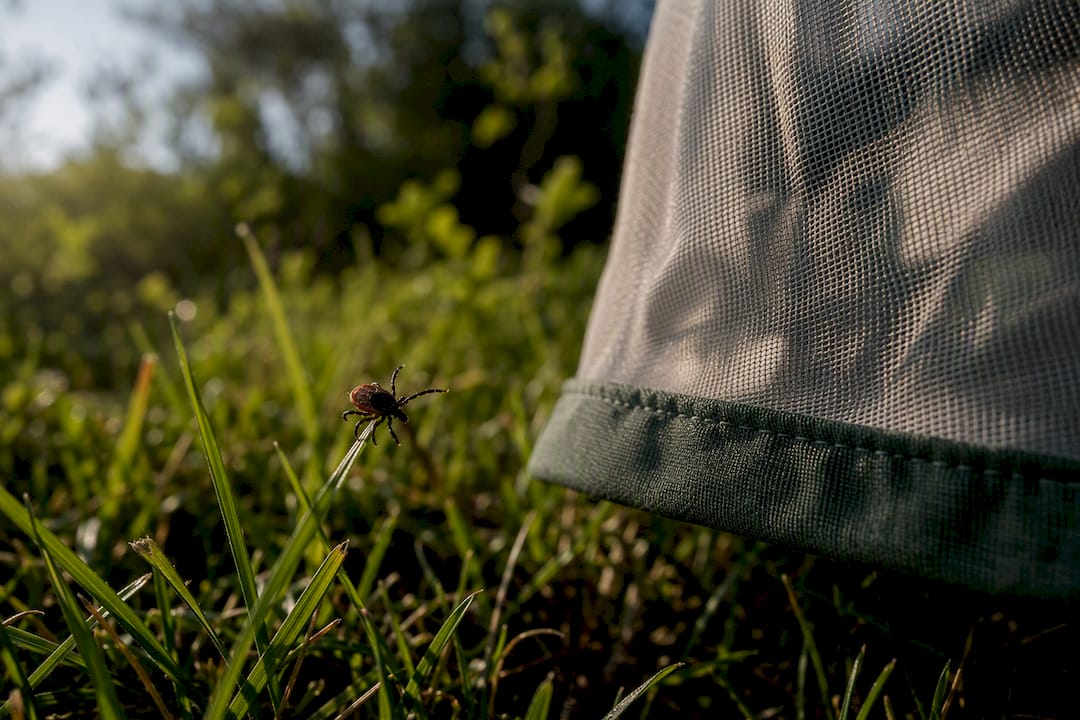
Ticks cannot climb mesh in the way most people picture climbing. They crawl, cling, and quest low to the ground, then scale a host once contact is made. Intact, tight-weave mesh stops most nymph and adult ticks cold. The real threat isn’t a tick scaling your tent wall. It’s a torn seam, a stretched cuff, or a tick that hitched a ride in on your boot.
TL;DR:
- Mesh’s effectiveness against ticks depends on the weave tightness, with no-see-um mesh preventing nymph-sized ticks from passing through damaged or loose fabric.
- Most tick bites happen on low vegetation or on clothing, not through climbing mesh, and ticks rely on contact with hosts or environment to move upward.
- Damage at seams, zippers, and cuffs significantly increases the risk of ticks reaching skin, especially if clothing or gear is torn or stretched.
- Proper outdoor habits, such as sealing cuffs, storing gear off the ground, and inspecting clothing and pets after outings, greatly reduce tick encounters.
- Mesh clothing provides a physical barrier but is not foolproof, and combining it with behavioral practices and gear choices offers the best protection.
Table of Contents
- Can Ticks Climb Mesh? What’s Actually Happening
- Does Mesh Weave Type Stop Ticks From Getting Through?
- Where Mesh Actually Fails: Seams, Gaps, and Hitchhikers
- Do Ticks Get Through Tent Mesh While You Sleep?
- How Chemical-Free Mesh Clothing Fits Into Tick Prevention
- Your Before, During, and After Checklist for Mesh Protection
- What Mesh Can and Can’t Promise You
- Which Bug Away Set Matches Your Outdoor Plans
- Sources
Can Ticks Climb Mesh? What’s Actually Happening
Ticks have no wings and no jumping legs. They can’t fly, they can’t leap, and they definitely don’t launch themselves at you from a tree branch, despite what campfire stories suggest. What they do instead is called questing. A tick climbs a blade of grass or a low shrub, usually no higher than about two feet, and waits with its front legs extended until something brushes past. The moment contact happens, it grabs on and starts climbing.
That single detail explains almost everything about why mesh works and why it sometimes doesn’t. Ticks don’t need to “climb mesh” from the outside in the way a spider scales a wall. Instead, they get carried onto a surface, whether that’s your pant leg, your dog’s fur, or a backpack strap, and once they’re there, they instinctively move upward. According to the CDC, ticks quest on low vegetation and attach through direct contact, not through independent flight or aerial ambush.
Once a tick lands on skin or fabric, its goal is simple: reach warm, moist, hidden skin. The New York State Department of Health notes that a tick on the body generally climbs upward until it finds a protected spot, which is why bites cluster around the hairline, behind the knees, in the groin, and under the arms.
A few behavioral facts matter here:
- Ticks can’t jump onto you from more than a few inches away.
- They rely entirely on contact with vegetation or another host to get moving.
- Different species quest at slightly different heights, but almost all stay below knee level.
- Once attached to fabric, a tick will search for gaps, seams, or thin spots rather than trying to push through solid material.
That last point is the whole game. A tick doesn’t scale a mesh barrier. It probes it, looking for a way around.
Does Mesh Weave Type Stop Ticks From Getting Through?
Not all mesh is built the same, and the difference matters more for ticks than for most other pests. Coarse, open-weave mesh, the kind you’d find on a budget screen tent or a loosely knit summer shirt, leaves gaps wide enough for a small tick to squeeze through. Fine, tight-weave mesh, often labeled “no-see-um” mesh in outdoor gear, closes those gaps down to a size that blocks almost everything except the smallest insects.
Life stage changes the equation. Adult ticks are roughly the size of a sesame seed and rarely get through quality mesh. Nymphs are a different story. About the size of a poppy seed, nymph-stage ticks are small enough to pass through coarse or damaged mesh with visible holes, according to the CDC. That’s a real concern because nymphs are also responsible for a large share of tick-borne disease transmission, since their bites are harder to notice.
Nymphs are the mesh test that actually matters. If a mesh product can stop a poppy-seed-sized nymph, it will stop an adult tick without any trouble. That’s why “no-see-um” grade specs are worth checking before you buy tent screens or protective clothing, rather than assuming any mesh labeled “bug netting” performs the same job.
A few practical signals tell you whether mesh will hold up:
- Hold it up to light. If you can see distinct, wide gaps between fibers, nymphs can likely pass through.
- Check for a manufacturer spec that says “no-see-um” or lists a pore size or micron rating.
- Inspect for tears, stretched sections, or loose stitching, since damage defeats even good mesh.
- Press on the fabric. A tight weave holds its shape; a loose one distorts easily under light pressure.
Audubon’s tick season guidance makes the same point from a different angle: loosely woven fabric offers little advantage over bare skin, and mesh only counts as protection when it’s specifically engineered to block ticks, not just larger insects like mosquitoes.
Where Mesh Actually Fails: Seams, Gaps, and Hitchhikers
Mesh rarely fails because a tick muscled through the fabric itself. It fails at the edges. Seams, zipper lines, and cuffs are where two pieces of material meet, and that junction is almost always weaker than the mesh itself. A tick that can’t push through tight weave will happily walk around it to an unsealed cuff, a gap where a zipper doesn’t quite close, or a seam that’s puckered from washing and wear.
Damaged or stretched fabric compounds the problem. The CDC points out that stretching, tearing, and loose knits all increase the chance a tick reaches skin, either by squeezing through or crawling along the opening the damage creates. A single snag from a branch can turn reliable mesh into a gap wide enough for a nymph.
The bigger issue for most people, though, isn’t the mesh at all. It’s what walks in wearing it. Clothing, backpacks, pets, firewood, and boots are the most common ways ticks get past any barrier, mesh or otherwise, because they’re carried in rather than crawled through. A dog that ran through tall grass, a jacket left on a picnic table, or a pile of firewood stacked against the house can all deliver a tick straight past your defenses without it ever testing the mesh.
Here’s a practical order of operations for closing those gaps:
- Patch or replace any mesh with visible holes, tears, or heavily stretched sections before your next outing.
- Seal cuffs, waistbands, and collar openings, either with built-in elastic or by tucking pants into socks and shirts into pants.
- Store boots, backpacks, and outdoor gear off the ground and away from direct contact with tall grass or brush.
- Check and launder clothing after outdoor exposure, since hot dryer cycles are effective at killing any ticks that hitched a ride.
Pro Tip: Tuck pants into socks before tucking your shirt into your pants. That double-seal closes the two spots, ankles and waist, where ticks most often find their way to skin. For a step-by-step version of this, Bug Away’s guide on tucking pants into socks walks through the technique in more detail.
Do Ticks Get Through Tent Mesh While You Sleep?
Tent mesh follows the same rules as clothing mesh. Intact no-see-um mesh prevents nymph and adult ticks from squeezing through, and the primary risk to campers isn’t the tent wall itself, it’s what gets carried inside on clothing, pets, or gear, according to Mom Goes Camping’s field guide on keeping ticks out of tents. A tick sitting outside your rainfly has no way to force its way through quality netting. It has plenty of ways to ride in on your daypack.
That shifts the priority away from obsessing over mesh grade and toward campsite habits. A few setup choices make a real difference:
- Keep tent doors zipped fully, even during short trips outside, rather than leaving them cracked for airflow.
- Use a footprint or ground tarp so gear set on the tent floor isn’t in direct contact with grass or dirt underneath.
- Store packs, boots, and jackets in the vestibule rather than the sleeping area whenever possible.
- Hang clothing instead of piling it on the tent floor, where a tick can drop off and quickly find a new host.
- Use sealed containers or dry bags for anything that spent time in brush or tall grass.
Entry and exit habits matter just as much as gear placement. Brush off clothing and give yourself a quick visual check before ducking into the tent, especially after hiking through brush or setting up camp in overgrown terrain. A fast body check before bed, focusing on the scalp, waistband, and behind the knees, catches most ticks before they’ve had time to settle in. Campers who treat this as routine, the way they’d check a stove valve or a headlamp battery, tend to have far fewer surprises than those who rely on tent mesh alone.
How Chemical-Free Mesh Clothing Fits Into Tick Prevention
Physical-barrier clothing works on a different principle than sprays or treated fabric. Instead of repelling ticks with a chemical signal, tight-weave mesh simply denies them a path to skin. That distinction matters for anyone who’d rather not put insecticide on their clothes or skin, especially for kids or for people who spend hours outside every week.
Some mesh clothing brands build garments around the physical-barrier idea rather than chemical treatment. Such lines may include chemical-free mesh materials designed to physically block ticks and insects rather than repel them, integrated coverage options to reduce the number of open cuffs and gaps ticks could exploit, money-back guarantees for fit and coverage, and customer feedback referencing zero tick bites among wearers.
A tight-weave physical barrier only works if it’s worn correctly. Tuck pants legs over boots or socks rather than letting them hang loose, since a gap at the ankle can compromise protection. Layer a jacket over a base layer during peak tick season rather than wearing it as your only layer, and check seams and cuffs periodically for stretching or wear the same way you’d check any outdoor gear. Bug Away’s guide on what to wear for ticks goes deeper into layering choices for different activities, from gardening to multi-day hikes.

Your Before, During, and After Checklist for Mesh Protection
Reducing tick exposure isn’t about finding one perfect product. It’s about stacking a few simple habits so that no single point of failure ruins the rest.
- Before you head out: Choose tight-weave mesh clothing, inspect your tent for tears or stretched seams, and tuck and seal cuffs before you’re in tall grass.
- During your activity: Keep tent doors zipped, keep packs and boots off the ground, and stay on trails rather than pushing through brush when you have a choice.
- After you’re back: Do a full-body check, focusing on the scalp, ears, waistband, and behind the knees, then launder clothing in hot water and check pets and gear before they come inside.
Pro Tip: If you find an attached tick, don’t twist or squeeze it. Use fine-tipped tweezers to grip it close to the skin and pull straight up with steady pressure. A tick removal comb designed for pets can also help with dogs that spent the day off-leash in brush.
The CDC’s guidance backs this layered approach directly: sealing openings, laundering clothing, and inspecting gear after outdoor exposure form the backbone of practical tick defense, alongside choosing the right fabric in the first place.
What Mesh Can and Can’t Promise You
Mesh clothing earns its place in a tick prevention plan, but it’s not magic, and treating it that way sets people up for a false sense of security. For most weekend hikers, gardeners, and families walking well-maintained trails, tight-weave mesh paired with sealed cuffs and a post-hike check covers the realistic risk. That combination handles the vast majority of exposure most people actually face.
Where I’d add more, permethrin-treated gear or a topical repellent, is for anyone working in dense brush for hours at a time, or spending regular time in a known high-density tick region. That’s not a knock on mesh. It’s just recognizing that a physical barrier and a chemical deterrent solve different parts of the same problem, and stacking them makes sense when the stakes go up.
The trade-off worth being honest about is comfort. Mesh breathes better than treated synthetic layers in most conditions, but no fabric is perfect in July heat. Match the gear to the activity: light mesh for a day hike, more layering and maybe an added repellent for a week of trail clearing in a hotspot. The goal isn’t finding one setup that handles everything. It’s picking the right tool for the exposure you’re actually walking into.
— Thomas
Which Bug Away Set Matches Your Outdoor Plans
Bug Away’s mesh clothing is built around the same principle covered throughout this guide: a tight, chemical-free physical barrier beats hoping a spray lasts through a humid afternoon.

Matching the right piece to your activity is straightforward. Hikers and gardeners who want leg coverage without full sleeves do well with the Bug Away Pants for men or Bug Away Pants for women. Anyone spending full days outdoors, camping trips, brush clearing, extended garden work, gets more complete coverage from the men’s combo set or women’s combo set, which pair a jacket and pants for sealed, integrated protection. Families heading out together can outfit kids with the Bug Away Kids Set, built with the same tight-weave mesh sized down for smaller frames. If you only need upper-body coverage for lighter activity, the men’s jacket or women’s jacket covers that on its own.
Every set carries Bug Away’s 30-day money-back guarantee, backed by feedback from over 500 customers who reported zero tick bites while wearing the gear. Browse the full lineup on the Bug Away shop page and pick the set that fits your next trip outdoors.
Sources
- Prevent tick bites | CDC
- Be Tick Free - A Guide for Preventing Lyme Disease | NY State Department of Health
- How to keep ticks out of tent | Mom Goes Camping