
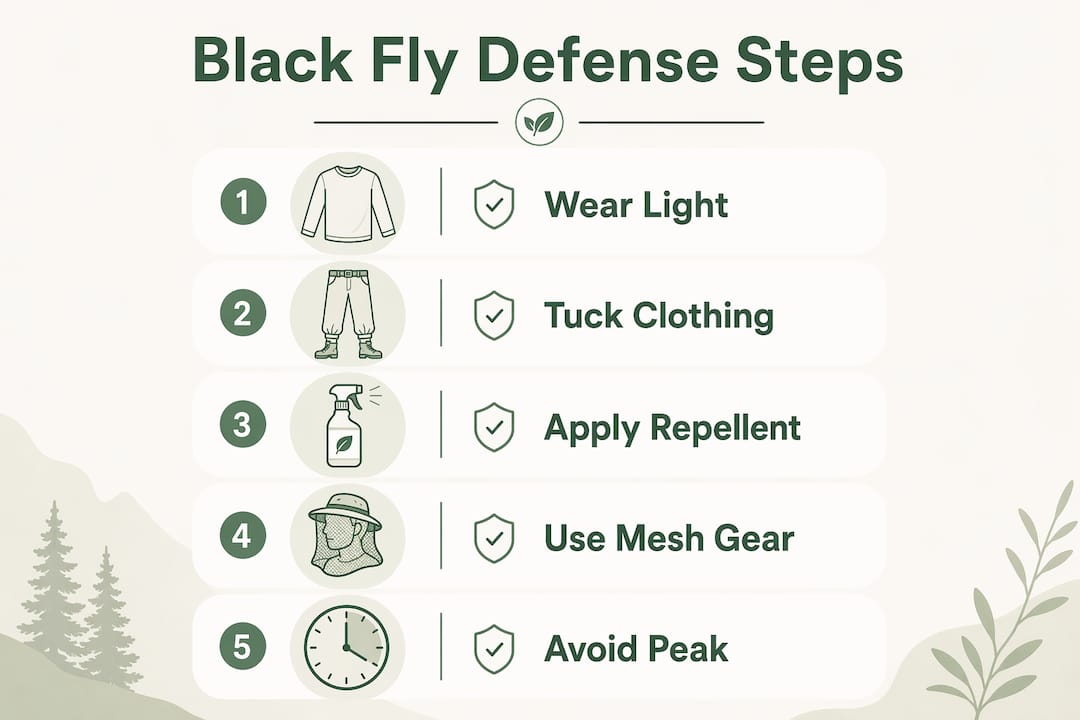
The most effective black fly protection combines physical barriers, smart timing, and targeted repellent use. No single method works alone. Here is what actually keeps you bite-free during peak season:
- Cover up completely: Light-colored, long-sleeved shirts and pants tucked into socks block most bites. Black flies don’t bite through fabric.
- Wear a head net: In high-activity areas, a black fly head net is the single most reliable barrier for your face and neck.
- Time your outings: Mid-day is your window. Black flies are least active between roughly 10 AM and 2 PM.
- Apply repellent at entry points: Focus DEET, picaridin, or IR3535 on wrists, ankles, and your waistband, where flies crawl under clothing.
- Skip the cologne: Scented toiletries attract black flies. Go unscented on any day you plan to be outdoors during peak season.
- Use smoke when stationary: Campfire smoke and punk sticks push flies away from your immediate area.
- Don’t scratch bites: Scratching breaks skin and raises infection risk. Use witch hazel or calamine lotion instead.
When and where black flies are most active
Peak activity in the U.S. and Canada runs mid-May through late June, though geography and weather shift that window considerably. A warm, wet spring can push emergence earlier; a cold snap delays it. The flies breed in clean, fast-running streams, which is why forested river valleys and lakeshores in the Northeast, Great Lakes region, and Pacific Northwest see the worst pressure.
Female black flies need a blood meal to develop eggs. That biological drive is what sends them after you. They’re most aggressive on warm, humid, overcast days and just before summer thunderstorms. Bright, dry mid-days are your safest bet outdoors.
Only a small number of the many known black fly species worldwide actually bite humans. In Algonquin Park alone, 42 species exist but only 4 are known to bite people. The problem is that those few species emerge in enormous numbers. Because black flies can travel up to 10 miles from their breeding sites, eliminating local populations is practically impossible. Personal protection is your only real defense.
| Region | Peak Season | Notes |
|---|---|---|
| New England (ME, NH, VT) | Mid-May to late June | Worst in river valleys and forested lowlands |
| Great Lakes (MI, MN, WI) | Mid-May to late June | Activity tied to snowmelt and stream flow |
| Pacific Northwest (OR, WA) | Mid-May to late June | Elevation affects timing significantly |
| Appalachian corridor (PA, NY) | Mid-May to late June | Shaded creek corridors see highest density |
| Canadian border regions | Mid-May to late June | Algonquin-style pressure in forested zones |
How clothing and timing reduce your exposure
Light-colored clothing is your first line of defense. Black flies are attracted to dark colors like green, brown, and red, so wearing orange, yellow, or light blue cuts your attractiveness to them. Tightly woven fabric matters too. Loose weaves let flies probe through; a dense cotton or synthetic blend does not.
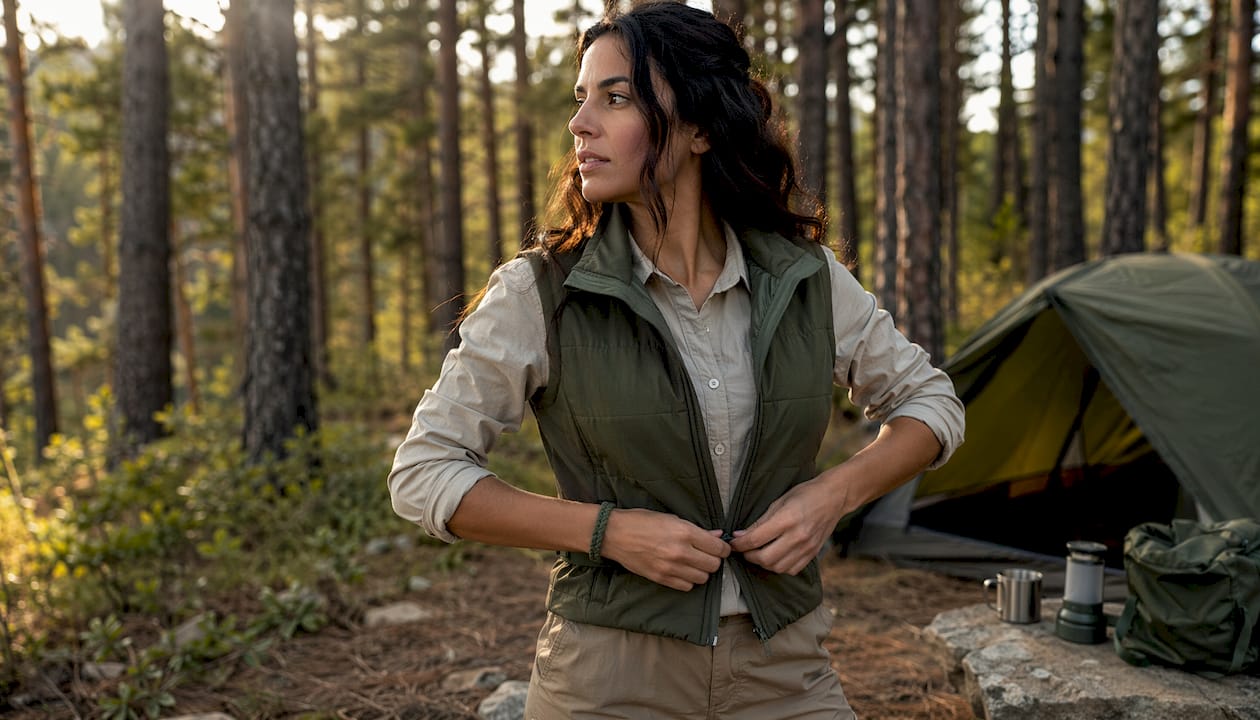
The tucking system sounds basic, but it works. Shirt into pants. Pants into socks or tall boots. Zippered shirts seal better than buttons, since flies find gaps around button plackets. Elastic cuffs at wrists and ankles close off the crawl routes flies use most.
Black fly head nets deserve more credit than they usually get. Modern black mesh nets weigh under 1 ounce and fit over a wide-brim hat without restricting your field of vision. Black-colored mesh reduces glare better than white or olive versions, which matters when you’re moving through a forest. A net rated at 620 holes per square inch blocks even the smallest biting insects while still allowing airflow.
Behavioral timing is often more effective than repellent use alone during peak season. Schedule outdoor activities during mid-day hours when flies are least aggressive. Avoid dawn, dusk, and any warm, cloudy, humid stretch. If a thunderstorm is building, go inside. Flies ramp up before pressure drops.
- Wear light-colored, tightly woven long sleeves and pants on every outing during black fly season.
- Tuck shirt into pants and pants into socks to close crawl routes at wrists, ankles, and waist.
- Add a head net over a wide-brim hat in areas with heavy fly pressure.
- Stay indoors or limit exposure on warm, overcast, humid days and before storms.
- Avoid lowlands, dense vegetation, and shaded creek corridors during peak hours.
Pro Tip: Apply repellent specifically at wrist cuffs, sock lines, and your waistband. These are the three spots black flies target when crawling under clothing. Treating only exposed skin misses the crawl-under threat entirely.
Which repellents actually work against black flies
DEET remains the most widely recognized option, but it comes with real trade-offs. It can dissolve plastic watch faces, synthetic jacket coatings, and eyeglass frames. It’s not recommended for infants, and some children are sensitive to it. Skin reactions, eye irritation, and in rare cases more serious neurological effects have been reported with heavy use.
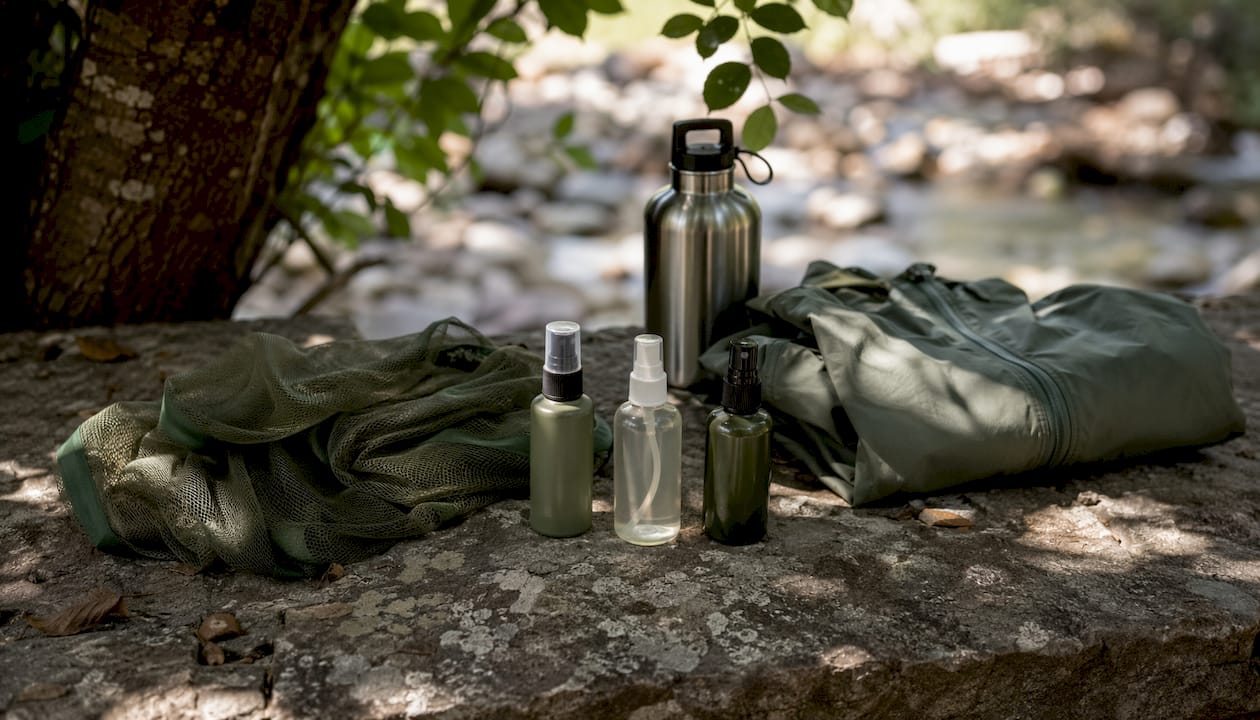
Picaridin and IR3535 are the practical alternatives. Both are nearly as effective as DEET against black flies, neither dissolves plastics or synthetic finishes, and no allergic reactions have been reported with either. IR3535 is commonly found in combination sunscreen-and-repellent products, which simplifies your kit. The catch with all three: they don’t last as long against black flies as they do against mosquitoes. Plan to reapply every few hours.
| Repellent | Effectiveness | Duration vs. Black Flies | Material Safety | Notes |
|---|---|---|---|---|
| DEET | High | Moderate (reapply often) | Damages plastics/synthetics | Not for infants; use with caution on children |
| Picaridin | High | Moderate | Safe on all materials | No reported allergic reactions |
| IR3535 | High | Moderate | Safe on all materials | Often combined with sunscreen |
| Citronella | Low to moderate | Short | Safe | Better as a supplementary deterrent |
Repellent use dos and don’ts:
- Apply to wrists, ankles, and waistband, not just exposed skin.
- Reapply every 2–3 hours during heavy activity or sweating.
- Never apply DEET to infants or use it near eyes and mouth.
- Do not spray repellent directly onto your face; apply to hands first, then wipe on.
- Store repellents away from synthetic gear, watch straps, and plastic lenses.
- Follow label directions on concentration. Higher DEET percentages extend duration but don’t increase effectiveness.
Natural deterrents that actually have some backing
Smoke is the most reliable natural deterrent. Campfire smoke, punk sticks, and tobacco products all push black flies away from your immediate space. This works best when you’re stationary at a campsite or work area. It’s not a solution for hiking, but for a fixed outdoor gathering, a well-placed fire or smoldering punk stick makes a real difference.
Scented toiletries attract black flies, so going unscented is itself a deterrent. Skip the cologne, scented deodorant, hairspray, and perfume on any day you’ll be outdoors during peak season. This one costs nothing and removes a genuine attractant.
Citronella and Vicks VapoRub get mentioned in folk remedy circles, and both have some anecdotal support as topical deterrents on clothing edges and exposed skin. Neither has the research backing of DEET or picaridin, but as supplementary measures they’re worth trying, especially for people who want to minimize chemical exposure.
- Use campfire smoke or punk sticks when stationary outdoors.
- Switch to unscented soap, deodorant, and hair products during black fly season.
- Try citronella-based products or Vicks VapoRub on clothing cuffs as a supplementary measure.
- Avoid floral or sweet-scented sunscreens; opt for fragrance-free formulas.
How to treat black fly bites
Black flies bite differently from mosquitoes. Instead of piercing skin, they cut and rupture it, which causes more swelling, redness, and itching. The reaction can look alarming even from a single bite. That’s normal, but it means bite care matters more than people expect.
Avoid scratching. Extension entomologists consistently flag this as the most important step. Scratching breaks the skin further and opens the wound to secondary bacterial infection. The itch is intense, but scratching makes the reaction worse and prolongs healing.
Soothing agents that work: witch hazel, aloe vera gel, and calamine lotion all reduce itching and inflammation without irritating the wound. An oral antihistamine like diphenhydramine (Benadryl) helps with systemic itching if bites are numerous. Cold compresses reduce swelling in the first hour.
Bite care dos and don’ts:
- Do apply witch hazel, aloe vera, or calamine lotion to reduce itching.
- Do use a cold compress within the first hour to limit swelling.
- Do take an oral antihistamine if you have multiple bites or a strong reaction.
- Don’t scratch, even when the itch is severe.
- Don’t use alcohol-based products directly on open bite wounds.
- Seek medical attention if you develop hives, difficulty breathing, or significant swelling beyond the bite site. These can signal an allergic reaction requiring prompt care.
How Bugawaygear’s mesh clothing changes the equation
Physical barriers outperform repellents when black fly pressure is high. Bugawaygear’s chemical-free mesh clothing takes that principle further than standard long sleeves. The ultrafine breathable mesh physically blocks insects and ticks without any chemical treatment, which matters for families with young children, pregnant women, or anyone who wants to avoid DEET entirely.
Over 500 customers report zero tick bites while wearing Bugawaygear products. The clothing covers the full body including integrated foot protection, closing off the crawl routes at ankles and wrists that repellents alone often miss. Sizes run for men, women, and kids, and the eco-responsible materials hold up through repeated outdoor use.
- 100% chemical-free: no DEET, no permethrin, no synthetic treatments.
- Ultrafine mesh physically blocks black flies, ticks, and other biting insects.
- Integrated foot coverage closes the ankle gap that standard pants leave open.
- Available for men, women, and children.
- Backed by a 30-day money-back guarantee.
Pro Tip: Layer Bugawaygear mesh clothing with a black fly head net and apply picaridin at wrist and ankle cuffs for a three-layer system that covers every exposure route. This combination handles even the worst black fly conditions in the Northeast and Great Lakes region.

Bugawaygear’s approach works because it removes the need to time repellent reapplication perfectly. The mesh does the blocking continuously, so you’re not racing against a two-hour repellent window during a full-day hike.
Do electronic or ultrasonic repellents work against black flies?
No. Electronic and ultrasonic repellent devices do not work against black flies. Multiple university extension programs have evaluated these devices, and none have found evidence of meaningful insect deterrence. The CDC does not recommend them as a substitute for proven repellents or physical barriers.
The appeal is obvious: a clip-on device that requires no application sounds convenient. But black flies respond to carbon dioxide, body heat, and visual cues like dark clothing. Sound frequencies don’t interrupt those attraction mechanisms. Save your money and put it toward a quality head net or a bottle of picaridin.
Reducing black fly breeding sites around your property
Black flies breed exclusively in clean, fast-running water. Standing water, ponds, and slow streams don’t support them. This means the breeding sites are almost always natural waterways, not something you created or can easily modify.
Because flies travel up to 10 miles from those breeding sites, treating a nearby stream has almost no effect on the population you encounter in your yard. State-level suppression programs, like Pennsylvania’s Black Fly Suppression Program, use Bacillus thuringiensis israelensis (Bti), a naturally occurring soil bacterium, applied to streams to kill larvae before they emerge. Bti is selective: it targets black fly and mosquito larvae without harming fish, birds, or other aquatic life.
For most homeowners and outdoor enthusiasts, environmental control means two things: knowing where the breeding streams are relative to your location, and timing your outdoor activities around emergence patterns. If you live within a few miles of a fast-running river or creek, expect heavier pressure from mid-May through late June. Landscape changes on your own property won’t move that needle.
Key Takeaways
Physical barriers combined with smart timing give you the most reliable defense against black flies during peak season.
| Point | Details |
|---|---|
| Peak season window | Mid-May through late June in all major black fly regions of the U.S. and Canada. Mid-day is the safest time to be outdoors. |
| Clothing is your first barrier | Light-colored, tightly woven long sleeves and pants tucked into socks block bites without any chemical exposure. |
| Repellent placement matters | Apply DEET, picaridin, or IR3535 at wrists, ankles, and waistband, not just on exposed skin. |
| Electronic devices don’t work | Ultrasonic and electronic repellents have no proven effect on black flies; stick to physical barriers and proven repellents. |
| Bite care starts with not scratching | Use witch hazel, aloe vera, or calamine lotion; scratching worsens the reaction and raises infection risk. |