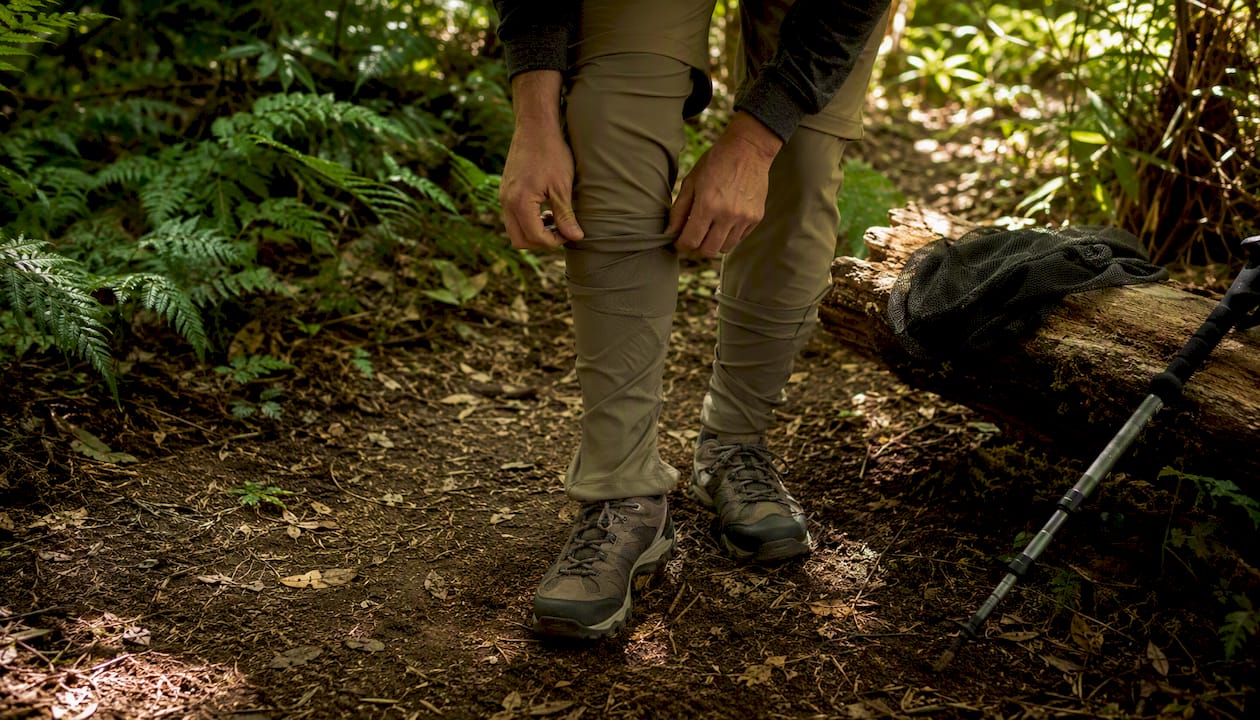
Together, these weigh under four ounces and cover every exposure window a single method misses.
Minimal packing checklist:
- Permethrin spray (treat clothing at home, 72 hours before your trip)
- 100-ml bottle of picaridin lotion or DEET
- Compact head net (under 1 oz)
- Long-sleeve shirt and full-length pants, tightly woven or fine mesh
- Gaiters or tall socks to seal the ankle gap
Why this system works:
- Coverage: Clothing handles the largest surface area; repellent covers exposed skin; the head net protects the face and scalp where neither clothing nor repellent is practical.
- Durability: Permethrin stays active through multiple washes, so your clothing works even when you forget to reapply lotion.
- Low weight: The entire chemical kit fits in a sandwich bag. Treated clothing adds zero trail weight.
Pro Tip: Treat your pants, socks, and gaiters with permethrin at least 72 hours before your trip. That gives the treatment time to bond to the fabric and dry completely, which improves both effectiveness and safety.
Key Takeaways
Effective backpacking mosquito protection requires layering permethrin-treated or physical-barrier clothing, a long-lasting skin repellent, and a head net, then choosing campsites that reduce exposure by design.
| Point | Details |
|---|---|
| Layer your defenses | Combine treated clothing, picaridin or DEET lotion, and a head net for full coverage. |
| Permethrin lasts | Properly applied permethrin stays effective through 4–6 wash cycles, so treat clothing before every trip. |
| Campsite selection matters | Breezy, elevated sites away from standing water cut mosquito pressure before any product is applied. |
| Head net is highest value | Under 1 oz and eliminates face and scalp bites entirely when worn over a baseball cap. |
| Bugawaygear reduces consumables | Chemical-free mesh pants and jacket provide physical-barrier protection with no insecticide, cutting your chemical kit weight. |
Table of Contents
- 1. What to wear for backpacking mosquito protection
- 2. How to treat clothing and gear with permethrin
- 3. Which skin repellents actually work on trail
- 4. How to set up camp to reduce mosquito pressure
- 5. Lightweight devices worth carrying (and what to skip)
- 6. Field first aid for mosquito bites
- 7. How to build a lightweight protection system for any trip
- Physical-barrier clothing that cuts your chemical load
- Sources
1. What to wear for backpacking mosquito protection
Clothing is your first and most durable line of defense. Andrew Skurka’s field-tested clothing system makes the point plainly: a bug-proof system starts with what you wear, not what you spray. Long sleeves and full-length pants eliminate the majority of exposed skin before you open a single bottle.
Fabric and fit
Tightly woven, quick-dry fabrics block more probes than loose knits. Mosquitoes can bite through thin, stretchy materials when fabric presses against skin, so slightly loose-fitting clothes matter more than most backpackers realize. A shirt that drapes rather than clings gives the fabric a small standoff distance from your skin. For a deeper look at fabric protection limits, the weave density is the deciding factor.
Light colors (tan, khaki, light gray) are worth choosing over dark ones. Mosquitoes use visual contrast to locate hosts, and dark fabrics increase that contrast against a bright sky. Light colors also stay cooler in direct sun, which matters on exposed ridgelines.
Gaiters, socks, and hats
The ankle gap between pants and socks is one of the most bitten spots on any trail. Tuck pants into tall socks, or add lightweight gaiters, to seal it. For your head, a baseball cap worn under a head net keeps the mesh off your face and scalp. Without the cap, the net sags against your skin and mosquitoes probe right through it. That one detail, noted in Skurka’s guide, is the difference between a head net that works and one that just annoys you.
Pro Tip: Pack a separate set of permethrin-treated camp clothes. Change into them when you stop moving. Sweat and heat attract mosquitoes, and treated clothing at rest is far more effective than treated clothing soaked through after eight miles.
2. How to treat clothing and gear with permethrin
Permethrin is an insecticide for fabrics, not for skin. Applied to clothing, it repels and incapacitates mosquitoes and ticks on contact. Consumer Reports confirms that properly applied permethrin treatments last through multiple wash cycles, making it one of the most durable tools in your kit.
Step-by-step home treatment
- Work outdoors or in a well-ventilated garage. Lay clothing flat on a tarp or hang it on a line.
- Hold the spray can 6–8 inches from the fabric and apply an even coat until the fabric is slightly damp, not soaked.
- Flip the garment and treat the other side.
- Allow items to dry completely, at least 2–4 hours in open air, before folding or packing.
- Treat pants, socks, gaiters, and the lower half of your shirt first. These are the highest-contact zones.
- You can also treat tent floors, pack covers, and hammock straps.
Safety notes
Wet permethrin is toxic to cats and fish. Keep pets away during application and drying, and never treat near water. Once fully dry, the treated fabric is considered safe for human contact. The EPA’s repellent guidance covers handling precautions and label-reading in detail.
Durability and weight
A typical spray-on treatment lasts 4–6 wash cycles or about six weeks of regular wear, whichever comes first. Rain reduces effectiveness faster than washing. Treated clothing adds no trail weight. If you’d rather skip the DIY step, factory pre-treated clothing is available and holds up longer, often through 70 or more washes, because the permethrin is bonded during manufacturing.
3. Which skin repellents actually work on trail
The CDC recommends using EPA-registered repellents on exposed skin as a core part of any mosquito prevention plan. Four actives dominate the backpacking market: DEET, picaridin, IR3535, and oil of lemon eucalyptus (OLE)
DEET
The most studied active. DEET at moderate concentration provides several hours of protection against mosquitoes. It works in almost every environment and against the widest range of insects. The trade-off: it can damage some synthetic fabrics and plastics (watch bands, trekking pole grips, sunglasses frames) and has a strong odor that some hikers find unpleasant.
Picaridin
Consumer Reports testing shows Picaridin at effective concentration performs similarly to DEET for mosquito repellency while being gentler on synthetics and plastics. Lotion formats hold up better in wet conditions than sprays.
OLE and IR3535
Oil of lemon eucalyptus (OLE, not the essential oil) is the only plant-based active the CDC recognizes as effective against mosquitoes, offering several hours of protection. IR3535 is a synthetic amino acid derivative, mild on skin, and effective for moderate-risk environments. Neither matches DEET or picaridin for duration in heavy-bug conditions, but both are solid options for lower-risk day hikes.
How to apply
Apply sunscreen first, then repellent. Repellent goes on top of sunscreen, not under it. Avoid eyes, mouth, and broken skin. Reapply after heavy sweating, swimming, or rain. The EPA’s repellent selector lets you filter by active ingredient, duration, and age group.
Pro Tip: Choose a pump spray or lotion over an aerosol for trail use. Pumps give you precise control, won’t pressurize in a hot pack, and are easier to apply to the back of your neck without overspray.
4. How to set up camp to reduce mosquito pressure
Campsite selection is often the most underrated move in backpacking bug protection. A breezy, exposed site on a rocky knoll will have a fraction of the mosquito pressure of a sheltered hollow next to a pond, even if you’re wearing the same gear.
Site selection rules
- Avoid low-lying ground, standing water, and dense brush within 50 feet of your tent.
- Prefer exposed rock, ridgelines, or open meadows where wind disrupts mosquito flight.
- Higher ground generally means fewer mosquitoes, especially at dawn and dusk when they’re most active.
- Set up before dusk. Every minute of open-tent time during peak hours is an invitation.
Hammock setup
A hammock bug net needs to cover the full ridgeline and drape past the hammock’s edges. The underside is the weak point: mosquitoes rise from the ground and probe the fabric from below. A structural ridgeline keeps the net taut and prevents sagging contact with your face. For no-see-ums, mesh density matters significantly. Sea to Summit’s Nano Mosquito Pyramid Net uses fine mesh that blocks mosquitoes effectively, but no-see-ums require even finer weave. Check mesh specs before buying if tiny biting midges are common in your target area.
Tent mesh and secondary nets
Standard backpacking tent mesh blocks mosquitoes but not no-see-ums. If you’re heading into coastal marshes or northern lake country in June or July, check whether your tent’s inner mesh is rated for smaller insects. A secondary no-see-um protection layer or a fine-mesh inner adds a few ounces and real peace of mind.
Food and scent management
Pack food in sealed bags and hang or bear-canister it away from your sleeping area. Avoid scented soaps, perfumes, and heavily fragranced sunscreens at camp. Floral and fruity scents attract insects. Unscented versions of everything from sunscreen to hand sanitizer are worth the small swap.
Pro Tip: Set up your tent or hammock net before you start cooking. The smell of food draws insects, and having your sleeping area sealed before dinner means you’re not chasing mosquitoes out of your tent at 9 PM.
5. Lightweight devices worth carrying (and what to skip)
Not every gadget earns its weight. Here’s what actually helps on a backpacking trip.
Compact Thermacell-style repellers
A butane-powered zone repeller creates a roughly 15-foot protected bubble using allethrin-soaked mats. At camp in still air, it works well for cooking and eating areas. The limitation is wind: even a light breeze disperses the repellent zone and cuts effectiveness sharply. Field guides confirm these devices are best for stationary, sheltered camp use. A compact unit plus one fuel cartridge weighs roughly 4–5 oz and provides about 12 hours of mat runtime.
Head nets
The single best weight-to-protection ratio in the entire kit. A quality head net weighs under 1 oz, packs to the size of a golf ball, and eliminates face and scalp bites entirely. Pair it with a baseball cap to keep the mesh off your skin. See head net options for hikers for a breakdown of mesh grades and fit styles.
Small battery fans
A personal clip-on fan creates a localized breeze that disrupts mosquito flight near your face. Useful at a picnic table or in a hammock. The battery drain limits runtime to a few hours on small units, and they add 3–6 oz depending on the model. Worth it for car campers; borderline for ultralight backpackers.
Mosquito coils
Cheap, effective in still air, and nearly weightless per night. The smoke deters mosquitoes in a small radius. The downside: they’re single-use consumables, they require a stable surface, and the smoke is unpleasant to breathe directly. Useful as a backup for high-bug camps when you’ve run out of Thermacell fuel.
What to skip
Ultrasonic repellers have no credible field evidence supporting their effectiveness against mosquitoes. Wristbands with DEET or citronella provide negligible protection beyond a few inches from the band. Neither earns pack space.
Pro Tip: If you’re going ultralight, skip the Thermacell and rely on your treated clothing, head net, and a well-chosen campsite. The device shines on base-camp trips where you’re stationary for multiple evenings in a buggy location.
6. Field first aid for mosquito bites
Most bites are an annoyance, not a medical event. Clean the bite with soap and water or an alcohol wipe, apply a cold pack or cold water for a few minutes, and resist scratching. Scratching breaks the skin and opens a path for secondary infection.
What to carry
- Hydrocortisone 1% cream: reduces itch and local inflammation. A small tube weighs almost nothing.
- Oral antihistamine (diphenhydramine or cetirizine): useful for multiple bites or a strong allergic response. Diphenhydramine causes drowsiness; cetirizine is non-drowsy.
- Alcohol wipes: dual-purpose for bite cleaning and general hygiene.
When to seek medical care
Most mosquito bites resolve in 24–48 hours. Seek care if you develop:
- Fever, chills, or body aches within two weeks of a trip
- Unusual rash, especially a spreading or bull’s-eye pattern
- Severe swelling, hives, or difficulty breathing (signs of a systemic allergic reaction)
- Neurological symptoms: headache, stiff neck, confusion
Regional disease risk is real. Mosquito-borne illnesses including West Nile virus, Eastern equine encephalitis, and dengue (in parts of Florida and Texas) are present in the United States. Before any trip, check the CDC’s mosquito prevention page for current regional alerts and disease risk. Symptoms can appear days to weeks after exposure, so mention recent outdoor travel to a doctor if you feel ill after a trip.
7. How to build a lightweight protection system for any trip
Three kits cover most scenarios. Choose based on your destination’s bug pressure and your weight tolerance.
| Kit | Items | Approx. weight |
|---|---|---|
| Minimal | Head net + 100-ml picaridin lotion + permethrin-treated pants and shirt | under 4 oz |
| Balanced | Minimal kit + compact Thermacell unit + 1 fuel cartridge | 7 oz |
| Comfort | Balanced kit + fine-mesh net shelter + treated gaiters | 12 oz |
Sequencing on trail
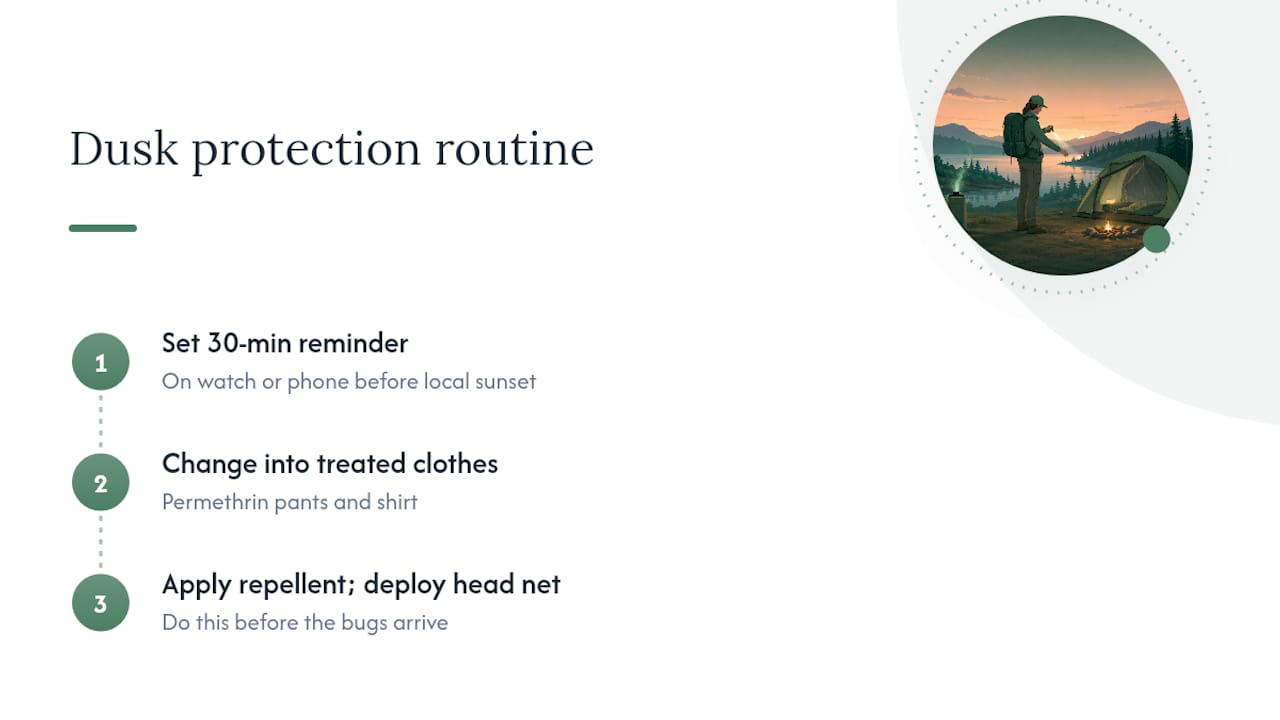
Wear your treated pants and gaiters while hiking. Keep your treated long-sleeve shirt accessible but not necessarily on during hot midday miles. At camp, put on the full treated layer before dusk and add the head net. Apply picaridin to any exposed skin (hands, neck, face) after you’ve changed.
Stretching your repellent
Apply repellent to pulse points (wrists, neck, ankles) and the edges of your clothing rather than coating every inch of skin. That approach extends a 100-ml bottle across 5–7 days of twice-daily application. Reapply after swimming or heavy rain, not on a fixed schedule.
Pro Tip: For ultralight trips where every ounce counts, the Bug Away mesh clothing system reduces your dependence on consumables. Physical-barrier clothing means less repellent used per day, which directly cuts the weight of your chemical kit.
A field note on layered defense
The layered approach to mosquito protection isn’t just theory. On a late-June trip through a Minnesota lake-country route, the difference between a miserable evening and a functional one came down to a single habit: changing into permethrin-treated camp clothes at the first sign of dusk and pulling on a head net before sitting down to cook. The mosquitoes were thick enough to form a visible cloud at the water’s edge, but with treated pants, a treated shirt, and a head net over a baseball cap, the bites dropped to near zero.
The one behavior that made the most difference wasn’t the repellent bottle. It was the timing. Changing clothes before the peak hour, not after, kept the treated fabric between skin and insects during the window when pressure was highest.
The single action worth copying: set a reminder on your watch or phone for 30 minutes before local sunset. That’s your cue to change, apply repellent to exposed skin, and deploy your head net. Do it before the bugs arrive, not in response to them.
Physical-barrier clothing that cuts your chemical load
If you’d rather reduce how much you spray on your skin and gear, Bugawaygear’s chemical-free mesh clothing is built for exactly that trade-off. The Bug Away Pants for men and Bug Away Pants for women use ultrafine breathable mesh that physically blocks mosquitoes and ticks without any insecticide treatment. The Bug Away Jacket for men pairs with the pants for full upper-body coverage.
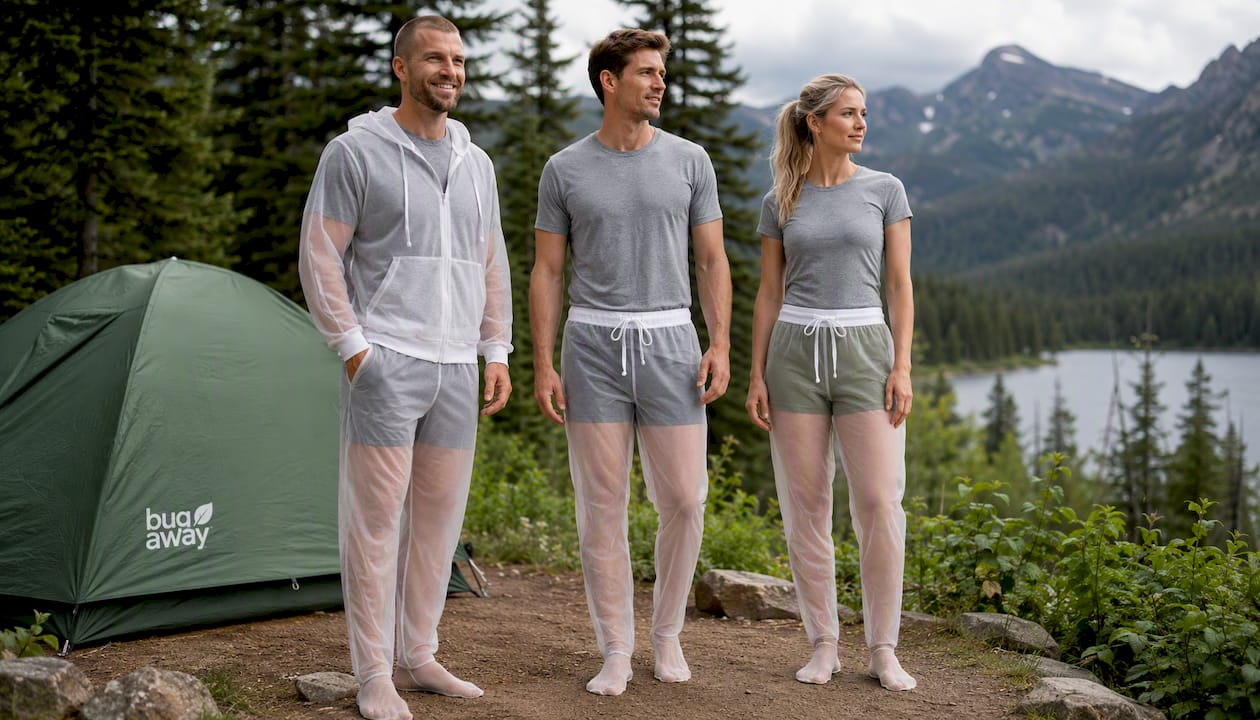
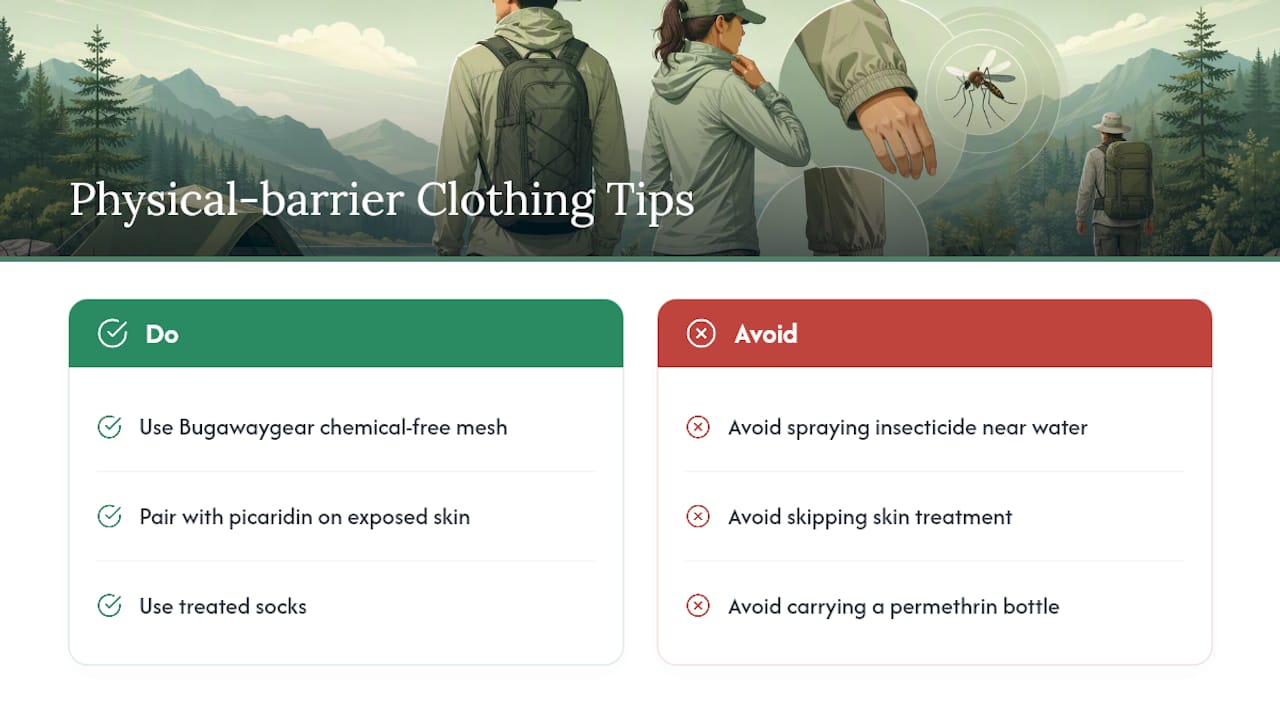
These are the right choice for lakefront camps where you’d rather not spray near water, for family hikes where you’re cautious about chemical exposure on kids, and for ultralight trips where eliminating a permethrin bottle from your kit saves both weight and prep time. Pair them with picaridin on exposed skin and treated socks, and you have a complete system with no synthetic insecticide touching your clothing at all.
All Bugawaygear products are made from eco-responsible materials and backed by a 30-day money-back guarantee. Browse the full chemical-free hiking gear collection and find the fit for your next trip.
Sources
- Mosquito prevention — CDC
- Find the repellent that is right for you — EPA
- Is permethrin-treated clothing safe and effective? — Consumer Reports
- My clothing system for backpacking in peak mosquito season — Andrew Skurka
This article is general information, not a substitute for advice from a qualified doctor. Consult a qualified healthcare professional about your own circumstances before acting on anything here.